

Best picks
Lithium-Ion vs Lead-Acid Jump Starters
Which Type Suits Your Vehicle
Lithium-ion vs lead-acid jump starters: compare weight, cable reach, recharging, storage temperatures and maker warnings across seven models.
By thisJOLT EditorialUpdated November 17, 20269 min read4 picks
On this page · The short answer
The short answer
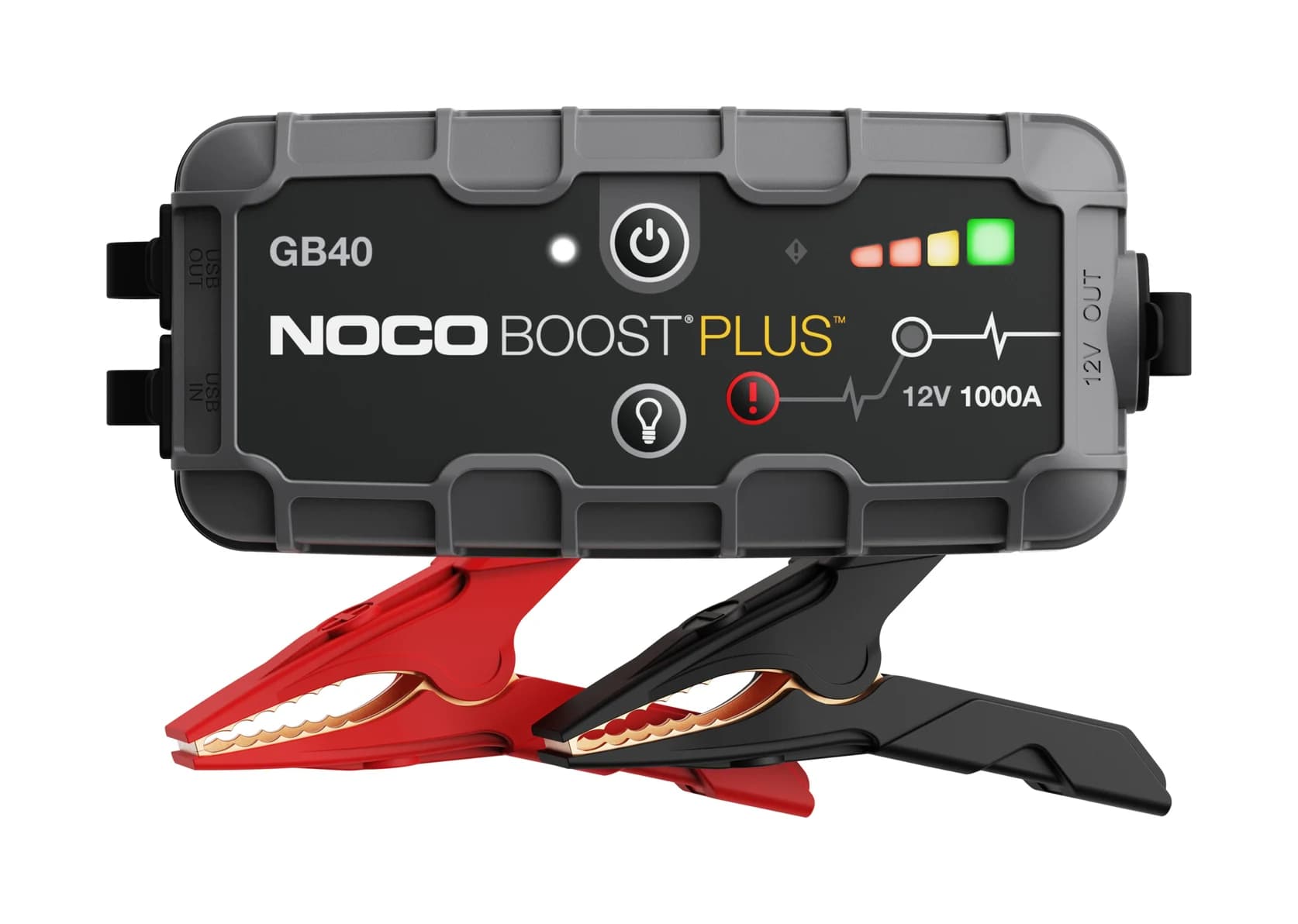
NOCO · GB40
NOCO 1000A Lithium - GB40
- Gas engine rating (maker's words)
- Up to 6.0 Liters
- Diesel engine rating (maker's words)
- Up to 3.0 Liters
- Starting rating, as labeled
- 1000 Amps (Peak)
- Check
- Does not state a cranking-amp figure; only peak-amp rating is published
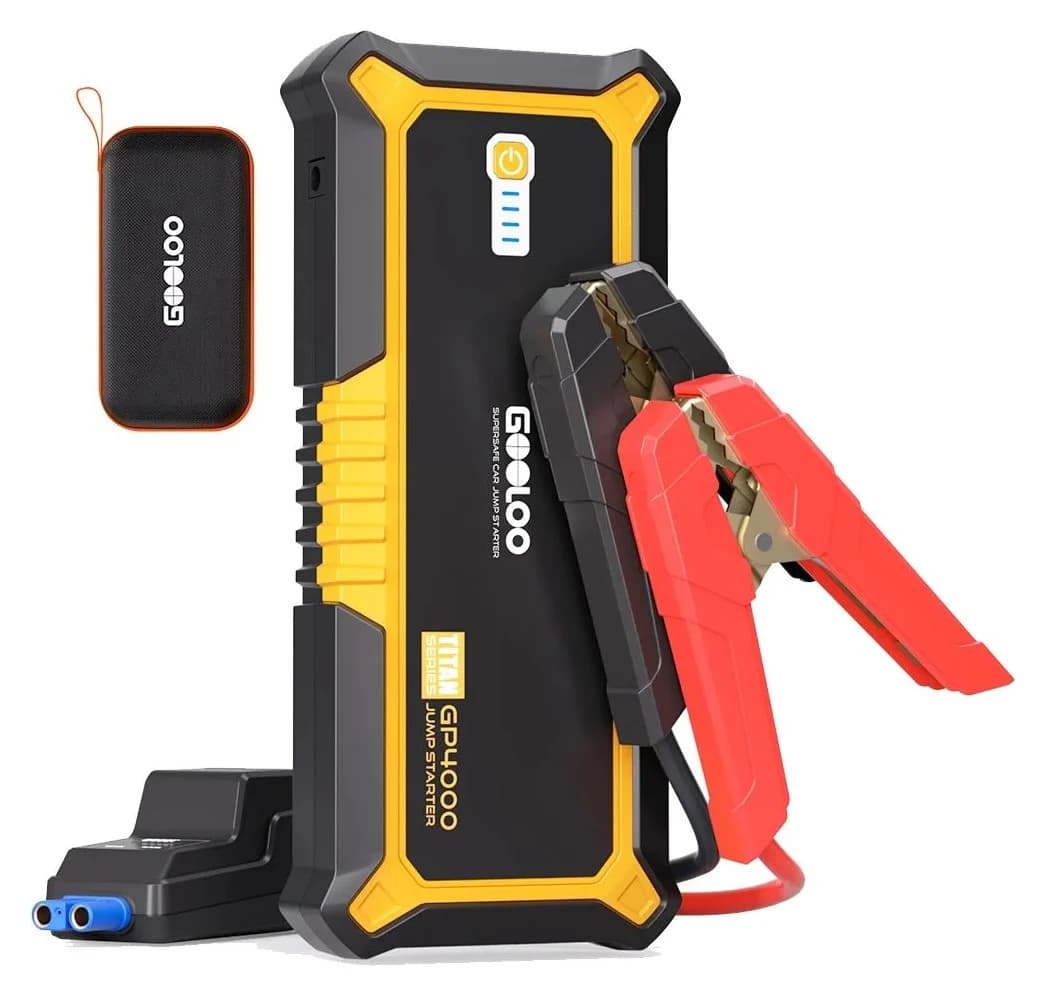
GOOLOO · GP4000
GP4000 4000A Supersafe
- Peak amps (maker)
- 4,000 A
- Vehicle system voltage
- 12V
- Pack chemistry (maker)
- lithium polymer battery
- Choose
- Lithium polymer, gas and diesel up to 10.0L
- Check
- No cranking amps or cold cranking amps figure published; the 4000A is labeled peak only
In the box: GOOLOO GP4000 Heavy-Duty Jump Starter + Smart Jumper Cables, USB-C Cable, EVA Case
Clore Jump-N-Carry JNC660
- Check
- The JNC660 includes a voltmeter for charge status and comes with a one-year limited warranty.
More picks (1)
- 4
Lead-acid, longer leads
Choose for: Lead-acid, longer leads
Check before buying: The JNC770R has a built-in 3A automatic charger and a one-year limited warranty, and its manual carries the same lead-acid-only and 50°F storage notes as the JNC660's.
Warnings and sources
Jump starters, battery chargers and compressors involve high current, battery gases, heat and pressure. Follow the maker’s manual for the exact model and your vehicle’s owner’s manual; this guide summarizes published specifications and is not a set of instructions.
This guide compares seven current jump starters from five makers: five lithium packs from NOCO, GOOLOO, Fanttik and CTEK, and two Clore Jump-N-Carry boxes whose manuals say each "contains a sealed non-spillable lead-acid battery". Only NOCO prints a weight for its lithium packs (2.45 lbs for the GB40, against 18 lbs and 23 lbs for the Clore boxes), and only Clore prints a cable length; for a pack you carry often, our pick is the NOCO GB40. Every number comes from the maker's own spec sheet, product page or manual, with conflicts reported when a maker's pages disagree.
Quick picks: the best lithium and lead-acid jump starters by use case
Compare specifications and all conditions
Small, carry-often
- Our pick
- NOCO GB40
- What the maker lists
- 2.45 lbs, 1000 amps (Peak), USB-C input, up to 20 jump starts (per NOCO)
Lithium polymer, gas and diesel up to 10.0L
- Our pick
- GOOLOO GP4000
- What the maker lists
- 4000A JUMPCORE starting power; one full charge delivers 60+ jump starts (per GOOLOO)
Lead-acid for shops and fleets
- Our pick
- Clore Jump-N-Carry JNC660
- What the maker lists
- 18 lbs, 1700 peak amps (425 cranking), 46″ #2 AWG welding cable leads
Lead-acid, longer leads
- Our pick
- Clore Jump-N-Carry JNC770R
- What the maker lists
- 23 lbs, 1700 peak amps (425 cranking), 68″ cable reach, dual USB outlets
Full comparison table
Swipe to compare. Row labels stay visible.
| Use case | Our pick | What the maker lists |
|---|---|---|
| Small, carry-often | NOCO GB40 | 2.45 lbs, 1000 amps (Peak), USB-C input, up to 20 jump starts (per NOCO) |
| Lithium polymer, gas and diesel up to 10.0L | GOOLOO GP4000 | 4000A JUMPCORE starting power; one full charge delivers 60+ jump starts (per GOOLOO) |
| Lead-acid for shops and fleets | Clore Jump-N-Carry JNC660 | 18 lbs, 1700 peak amps (425 cranking), 46″ #2 AWG welding cable leads |
| Lead-acid, longer leads | Clore Jump-N-Carry JNC770R | 23 lbs, 1700 peak amps (425 cranking), 68″ cable reach, dual USB outlets |
Scroll horizontally to see every column
| Use case | Our pick | What the maker lists |
|---|---|---|
| Small, carry-often | NOCO GB40 | 2.45 lbs, 1000 amps (Peak), USB-C input, up to 20 jump starts (per NOCO) |
| Lithium polymer, gas and diesel up to 10.0L | GOOLOO GP4000 | 4000A JUMPCORE starting power; one full charge delivers 60+ jump starts (per GOOLOO) |
| Lead-acid for shops and fleets | Clore Jump-N-Carry JNC660 | 18 lbs, 1700 peak amps (425 cranking), 46″ #2 AWG welding cable leads |
| Lead-acid, longer leads | Clore Jump-N-Carry JNC770R | 23 lbs, 1700 peak amps (425 cranking), 68″ cable reach, dual USB outlets |
- 2.45 lbsNOCO GB40 weight (lithium-ion), per NOCO's spec table
- 18 lbsClore JNC660 weight (sealed lead-acid, per its manual), per Clore
- 68″Clore JNC770R cable reach, per Clore
Pack chemistry, in each maker's words
NOCO lists a "24 Watt-Hour Lithium-Ion" internal battery for the GB40 and "56 Watt-Hour Lithium-Ion" for the GB70. GOOLOO says the GP4000 "uses a lightweight lithium polymer battery", Fanttik calls the T8 APEX "this lithium car battery jump starter", and CTEK calls its RB Series "High-output lithium jump starters". Clore's JNC660 and JNC770R product pages say only "Clore PROFORMER battery technology"; the operator's manual each page links says "This unit contains a sealed non-spillable lead-acid battery."
Weight differences: lithium packs vs lead-acid boxes
NOCO lists the lithium-ion GB40 at "Weight: 2.45lbs (1.11kg)" and the GB70 at "Weight: 4.18lbs (1.9kg)"; Clore lists the JNC660 at "Weight : 18 lbs." and the JNC770R at "Weight : 23 lbs". GOOLOO, Fanttik and CTEK state no weight for the GP4000, T8 APEX or RB 1500. NOCO's own pages disagree slightly: the GB40 overview says "weighing just 2.4 pounds" and the GB70 overview "weighing just 5.0 pounds"; the figures above come from the spec tables.
Lead length is a Clore-only figure here (46″ and 68″ #2 AWG welding cable leads); NOCO lists "Heavy-Duty Precision Battery Clamps" with no length, and the other lithium makers print none.
Starting power: labels matter, but amps alone don't rank jump starters
Jump starters don't get compared by amp numbers because the labels differ. Only Clore states cranking amps (425) alongside peak amps (1700) on both the JNC660 and JNC770R. NOCO lists "1000 Amps (Peak)" for the GB40 and "2000 Amps (Peak)" for the GB70. GOOLOO's GP4000 says both "4000A of JUMPCORE starting power" and "4000A Peak Power." Fanttik's T8 APEX page says "Rated at 2000 Amps", and Fanttik's comparison table gives the T8 APEX "2000A" in its "Peak Amps" row; the 1300A and 4000A in that row belong to the T8 and the T8 MAX. CTEK's RB 1500 says "1500 A battery peak current."
Because each maker labels its own numbers differently, we never rank or compare amps across brands. The engine size limits in a maker's own words lead the buying decision instead.
Engine ratings: gas and diesel limits in makers' words
Only the lithium packs print engine sizes, each in its maker's words: NOCO rates the GB40 for gas engines up to 6.0 liters and diesel up to 3.0 liters, and the GB70 for gas "Up to 8.0 Liters" and diesel "Up to 6.0 Liters"; GOOLOO says the GP4000 covers "12V gas and diesel up to 10.0L"; Fanttik lists the T8 APEX "up to 8.5L gasoline engines and 6.0L diesel engines"; CTEK lists the RB 1500 for "up to 6L petrol / 3L diesel". Clore's product pages and manuals state no engine size for the JNC660 or JNC770R.
Recharging options: how to power back up
The NOCO GB40 recharges from any powered USB port at 2.1 amps (USB-C input of 5 Volts 2.1 Amps Max per NOCO). GOOLOO's product page says the GP4000 is fully powered in about 5 hours using USB-C and a wall charger, and the wall charger is not included. Fanttik says the T8 APEX "completely recharges in 1.5 hours" with "65W USB-C power delivery input and output". Clore's JNC660 features auto recharging circuitry with a built-in automatic charger, and the JNC770R has a built-in 3A automatic charger. CTEK's page gives no RB 1500 recharge figure.
The lithium packs also list USB outputs: the GB40 has a USB Output of 5 Volts 2.1 Amps Max; the GP4000 provides dual USB ports and Type-C input/output; the T8 APEX offers 65W USB-C and 18W USB output; the RB 1500 lists "Use as a portable powerbank (8 000 mAh)". Clore's boxes have outlets too: the JNC660 lists a "12VDC outlet to power accessories" and no USB outlet, and the JNC770R adds "Dual USB outlets (2.1A and 1.1A) to power small electronics".
Storage temperatures and warnings
Each maker words its temperature limits differently, so they are listed here, not ranked. GOOLOO gives the GP4000 "operating and storage temperatures of -20°C to 60°C (-4°F to 140°F)" and warns: "If the ambient temperature is above 60°C (140°F), the internal cell construction of the lithium polymer battery may be damaged, causing it to swell and become unsafe. Do not store the device in a vehicle parked in hot weather for long periods of time." Fanttik lists a 5°F-113°F "Working Temperature" for the T8 APEX and prints no temperature warning on its product page. CTEK gives its RB Series "temperatures from -20°C to +50°C" for engine starts, with no separate storage range, and says the packs hold "their standby charge for 6 to 8 months between uses".
Clore's JNC660 and JNC770R manuals say "For optimum performance, do not store your Jump-N-Carry below 50°F when using as a jump starter" and "The ideal storage environment is room temperature, or 68ºF." The two manuals disagree on one line, and we report both as printed: the JNC660 manual says "Temperatures above 70ºF decrease amperage output", the JNC770R manual "Temperatures below 70ºF decrease amperage output". Both also warn "NEVER charge or jump start a frozen battery.", that the unit "should never be left in a completely discharged state for any period of time", and that "All lead-acid batteries (car, truck and boat) produce hydrogen gas which may violently explode in the presence of fire or sparks."
NOCO's GB40 and GB70 print no temperature range or warning on their product and spec pages.
How to choose the right type for your needs
Lithium packs make sense when:
- You carry the starter often: NOCO lists the GB40 at 2.45 lbs, against 18 lbs and 23 lbs for Clore's boxes
- You want USB-C recharging: NOCO, GOOLOO and Fanttik list USB-C input; Clore's boxes use a built-in charger
- Your engine is within the maker's printed rating (Clore prints no engine size)
Lead-acid boxes make sense when:
- You want a printed lead length: 46″ (JNC660) or 68″ (JNC770R); the lithium makers here print none
- You work in a shop or fleet, where Clore pitches the JNC660
- You want cranking amps on the spec sheet: only Clore states them (425, beside 1700 peak amps)
- You can store it where Clore's manuals ask: not below 50°F when using it as a jump starter, ideally at "room temperature, or 68ºF"
For the NOCO GB40: choose if you want the lowest listed weight here (2.45 lbs), USB-C recharging and up to 20 jump starts (per NOCO) for daily drivers and compact car kits.
For the GOOLOO GP4000: choose if your engine is within GOOLOO's "12V gas and diesel up to 10.0L" rating and you want its stated -4°F to 140°F operating and storage range.
For the Clore JNC660: choose if you want a sealed lead-acid box (per its manual) with 46″ leads, a 12VDC outlet and a built-in charger, and 18 lbs is manageable.
For the Clore JNC770R: choose if you want the longest printed leads here (68″), dual USB outlets and a built-in 3A charger, and 23 lbs is acceptable.
For more portable jump starters, see our portable jump starter guide; for Clore's two boxes side by side, see Jump-N-Carry JNC660 vs JNC770R.
Best small lithium-ion: NOCO GB40
The NOCO GB40 is a compact lithium-ion jump starter weighing 2.45lbs with 1000 Amps (Peak) of starting power. NOCO rates it for gas engines up to 6.0 liters and diesel up to 3.0 liters, and it recharges from any powered USB port (USB-C input of 5 Volts 2.1 Amps Max per NOCO). Its spec table lists a USB Output of 5 Volts 2.1 Amps Max. NOCO's overview page says up to 20 jump starts. The GB40 includes a USB-C to USB-C cable and microfiber storage bag.
Best lithium polymer pack: GOOLOO GP4000
GOOLOO lists "4000A of JUMPCORE starting power" for the GP4000 and says it "uses a lightweight lithium polymer battery"; per GOOLOO, one full charge delivers 60+ jump starts. GOOLOO rates it for 12V gas and diesel up to 10.0L, and its product page says it is fully powered in about 5 hours using USB-C and a wall charger (not included). The GP4000 operates at temperatures from -4°F to 140°F and provides dual USB ports and Type-C input/output. GOOLOO's page lists "Up To 30 Months Warranty" without saying what sets the term.
Best lead-acid for shops and fleets: Clore JNC660
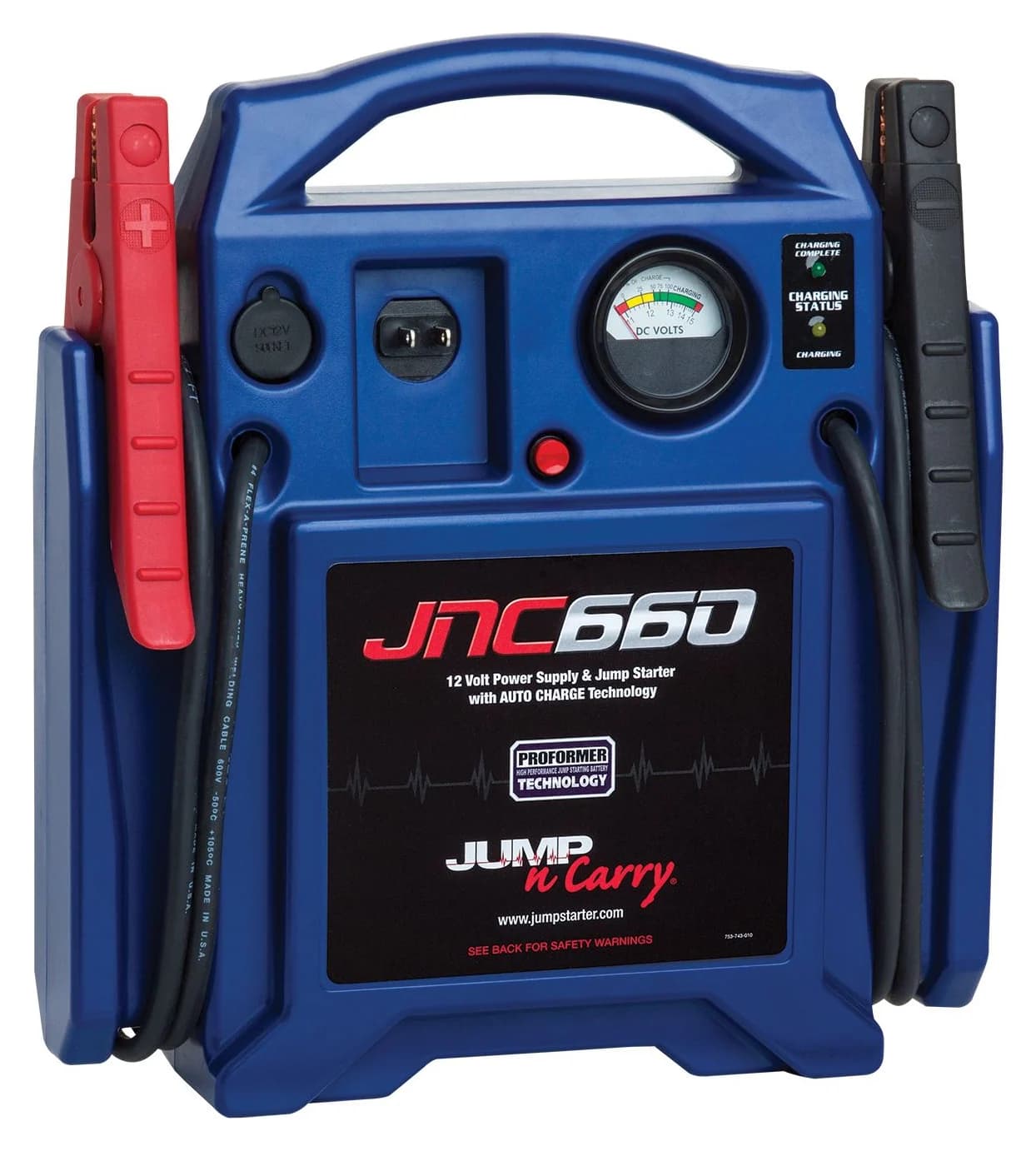
Clore lists the Jump-N-Carry JNC660 at 18 lbs with 1700 peak amps (425 cranking) and 46″ #2 AWG welding cable leads, and calls it "a favorite piece of equipment for automotive service garages, car dealerships, towing operations and busy fleet service facilities". Its operator's manual says "This unit contains a sealed non-spillable lead-acid battery." It features auto recharging circuitry with a built-in automatic charger and a 12VDC outlet to power accessories. The JNC660 includes a voltmeter for charge status and comes with a one-year limited warranty. Its manual says to use it "for jump starting lead-acid batteries only" and advises against storing it below 50°F when using it as a jump starter.
Best long-reach lead-acid: Clore JNC770R
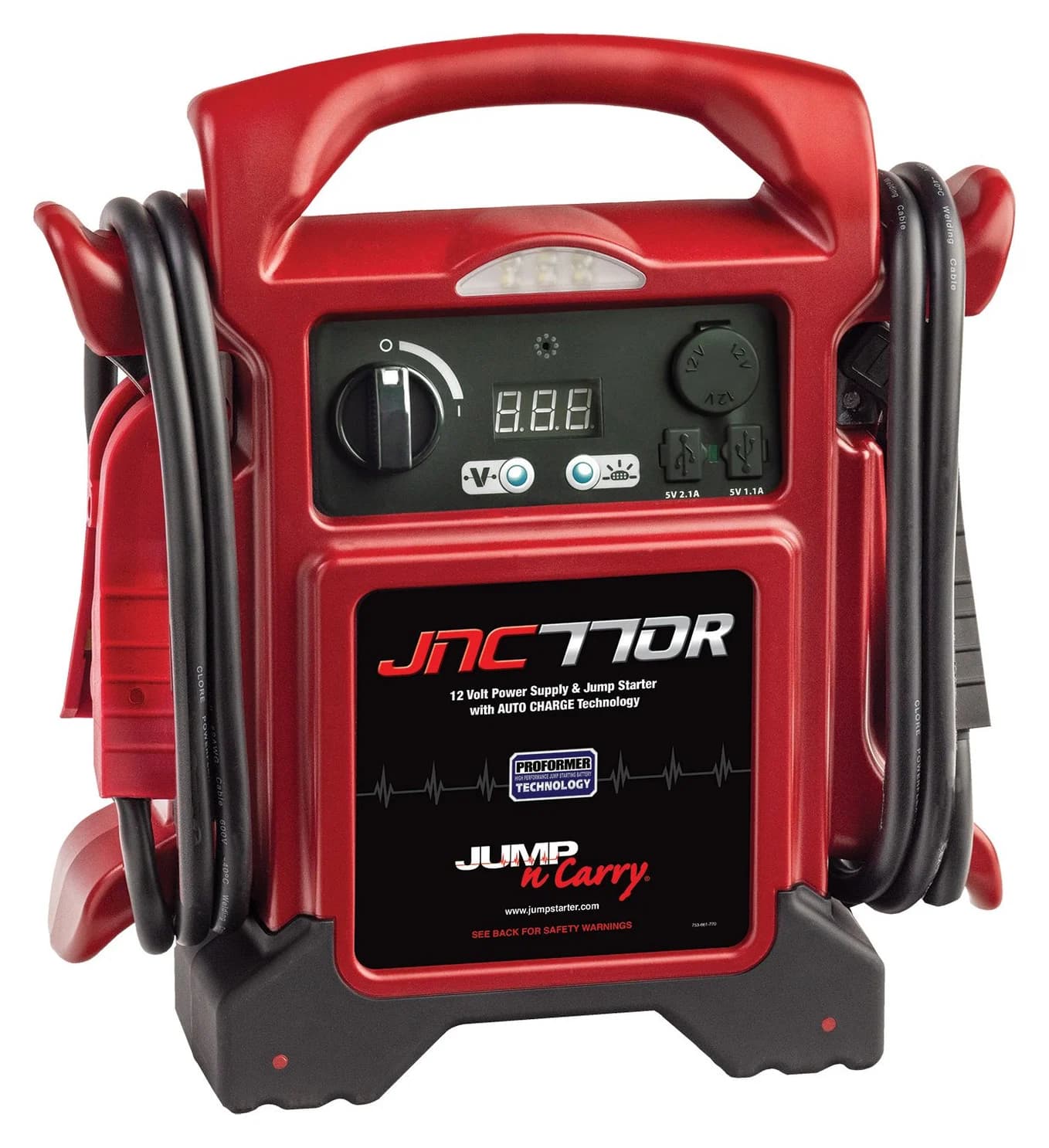
Clore lists the Jump-N-Carry JNC770R at 23 lbs with 1700 peak amps (425 cranking) and 68″ #2 AWG welding cable leads ("Cable Reach : 68″" in its spec table). Its operator's manual also says "This unit contains a sealed non-spillable lead-acid battery." It features dual USB outlets (2.1A and 1.1A) to power small electronics and a 12VDC outlet to power accessories. The JNC770R has a built-in 3A automatic charger and a one-year limited warranty, and its manual carries the same lead-acid-only and 50°F storage notes as the JNC660's.
How we choose
We rank these units on makers' published specifications, not on lab testing we haven't done. For each pick we read the maker's product page and spec table, plus the operator's manuals Clore links for its two boxes, and favor current models. Where a maker's own pages conflict, we report both versions, such as NOCO's two GB40 weights and the 70ºF line in Clore's manuals. We exclude anything discontinued and never open Amazon pages; every figure traces to an official source.
Verdict
On the makers' own figures, NOCO's lithium-ion GB40 and GB70 list lower weights (2.45 lbs and 4.18 lbs) than Clore's two sealed lead-acid boxes (18 lbs and 23 lbs), while the Clore boxes add printed lead lengths, cranking amps beside peak amps and a built-in automatic charger. Choose the NOCO GB40 for the lowest listed weight with USB power; the GOOLOO GP4000 if your engine is within its 12V gas and diesel up to 10.0L rating; the Clore JNC660 for shop and fleet use with 46″ leads; and the Clore JNC770R for the longest printed leads here, 68″.
Every number here comes from the maker's own spec sheet, product page or manual - we compare specifications, we don't test units in a lab.
Frequently asked questions
Which type is better for frequent carrying?
Of the weights the makers list, NOCO's lithium-ion GB40 is lowest at 2.45 lbs (its overview page says 2.4 pounds) and the GB70 is 4.18 lbs, against 18 lbs for Clore's sealed lead-acid JNC660 and 23 lbs for its JNC770R. GOOLOO, Fanttik and CTEK list no weight for the GP4000, T8 APEX or RB 1500, so they can't be placed on that scale.
When should I choose a lead-acid box instead of lithium?
When you want what Clore lists for its two boxes: printed lead lengths (46″ on the JNC660, 68″ on the JNC770R, both #2 AWG), cranking amps beside peak amps, and a built-in automatic charger. Their manuals also ask for upkeep: recharge when first purchased, immediately after each use and every three months if not used, and for optimum performance do not store the unit below 50°F when using it as a jump starter.
How do I decide between the NOCO GB40 and GOOLOO GP4000?
Start with each maker's engine rating. NOCO rates the GB40 for gas engines up to 6.0 liters and diesel up to 3.0 liters; GOOLOO says the GP4000 covers 12V gas and diesel up to 10.0L. NOCO lists the GB40 at 2.45 lbs, while GOOLOO lists no weight. Their amp figures carry different labels, NOCO's 1000 Amps (Peak) and GOOLOO's 4000A of JUMPCORE starting power, so we don't rank them against each other.
What's the real difference in cable reach?
Only Clore prints a length: 46″ #2 AWG welding cable leads on the JNC660 and 68″ on the JNC770R, and Clore says the JNC660's leads give easy access to dead batteries even in tight, hard-to-access spots. NOCO lists Heavy-Duty Precision Battery Clamps for the GB40 with no length or gauge, and GOOLOO, Fanttik and CTEK print none, so the lithium packs' reach can't be compared.
How does temperature range affect choice?
Each maker words its limits differently, so we list them rather than rank them. GOOLOO gives the GP4000 operating and storage temperatures of -20°C to 60°C (-4°F to 140°F); Fanttik lists a 5°F-113°F working temperature for the T8 APEX; CTEK gives its RB Series temperatures from -20°C to +50°C; Clore's manuals say not to store the Jump-N-Carry below 50°F when using it as a jump starter. NOCO prints no range.
What's the trade-off between weight and performance?
Weight is a figure NOCO and Clore print under the same label: 2.45 lbs for the lithium-ion GB40 against 23 lbs for the sealed lead-acid JNC770R. For that weight, Clore lists 68″ cable reach, 425 cranking amps beside 1700 peak amps, dual USB outlets (2.1A and 1.1A) and a built-in 3A automatic charger. Starting power itself isn't compared, because the amp labels differ by brand.

Related guides
Best picks · Jump Starters
Portable Jump Starters for Cars in 2026: Picked by the Engine Sizes Their Makers Name
Portable jump starters grouped by engine sizes their manufacturers quote for gas and diesel.
Comparison · Jump Starters
NOCO GB150 vs GBX155: Boost PRO vs Boost X for Large Engines
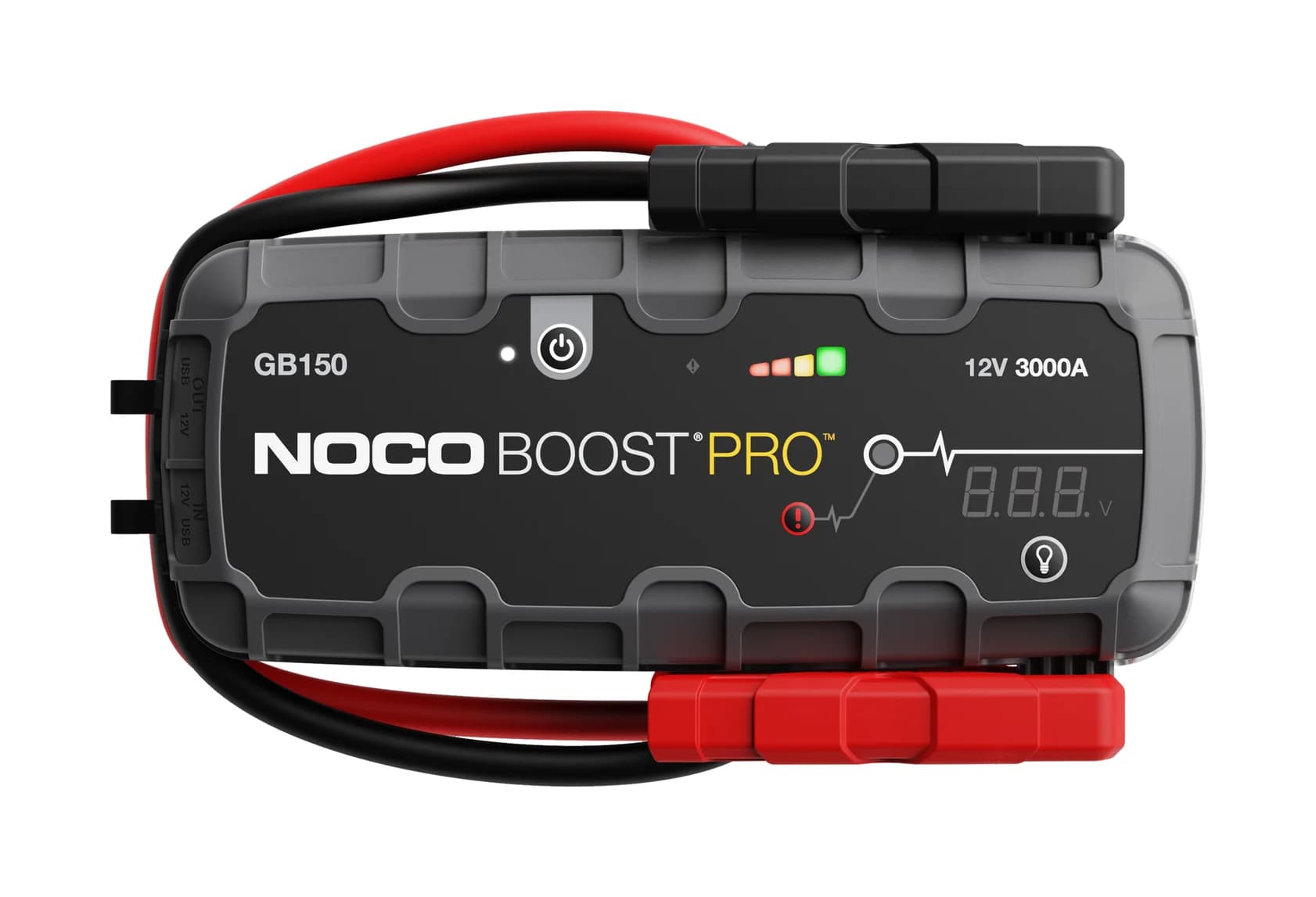
NOCO rates the GB150 (3000A peak) for gas up to 9.0 liters and diesel up to 7.0 liters; the GBX155 (4250A peak) for gas up to 10 liters and diesel up to 8.0 liters. Every difference that matters.
Comparison · Jump Starters
NOCO GB40 vs GB70: Which Boost Jump Starter Matches Your Engine
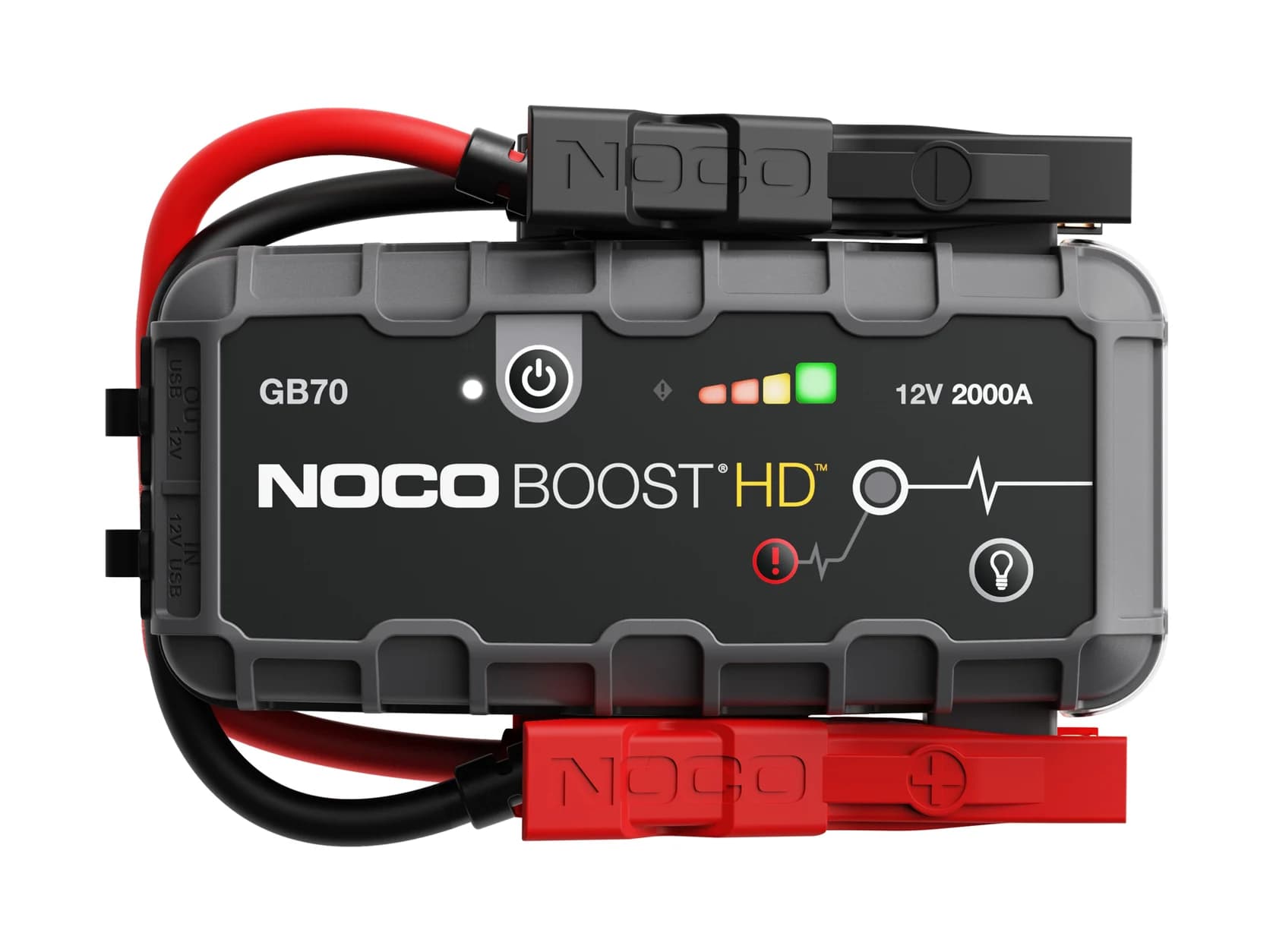
NOCO rates the GB40 for gas up to 6.0 liters and diesel up to 3.0 liters, while the GB70 handles gas up to 8.0 liters and diesel up to 6.0 liters. Here's how to pick the right one.