

Buying guide
Schumacher SC1281 Review
6V/12V Charger with 100A Engine Start, Explained
What Schumacher's SC1281 6V/12V plug-in charger does in each mode, its chemistry-list discrepancy, and why its engine-start amps need AC power.
By thisJOLT EditorialUpdated November 17, 20265 min read
On this page · Schumacher SC1281: Schumacher Electric SC1281
Warnings and sources
Jump starters, battery chargers and compressors involve high current, battery gases, heat and pressure. Follow the maker’s manual for the exact model and your vehicle’s owner’s manual; this guide summarizes published specifications and is not a set of instructions.
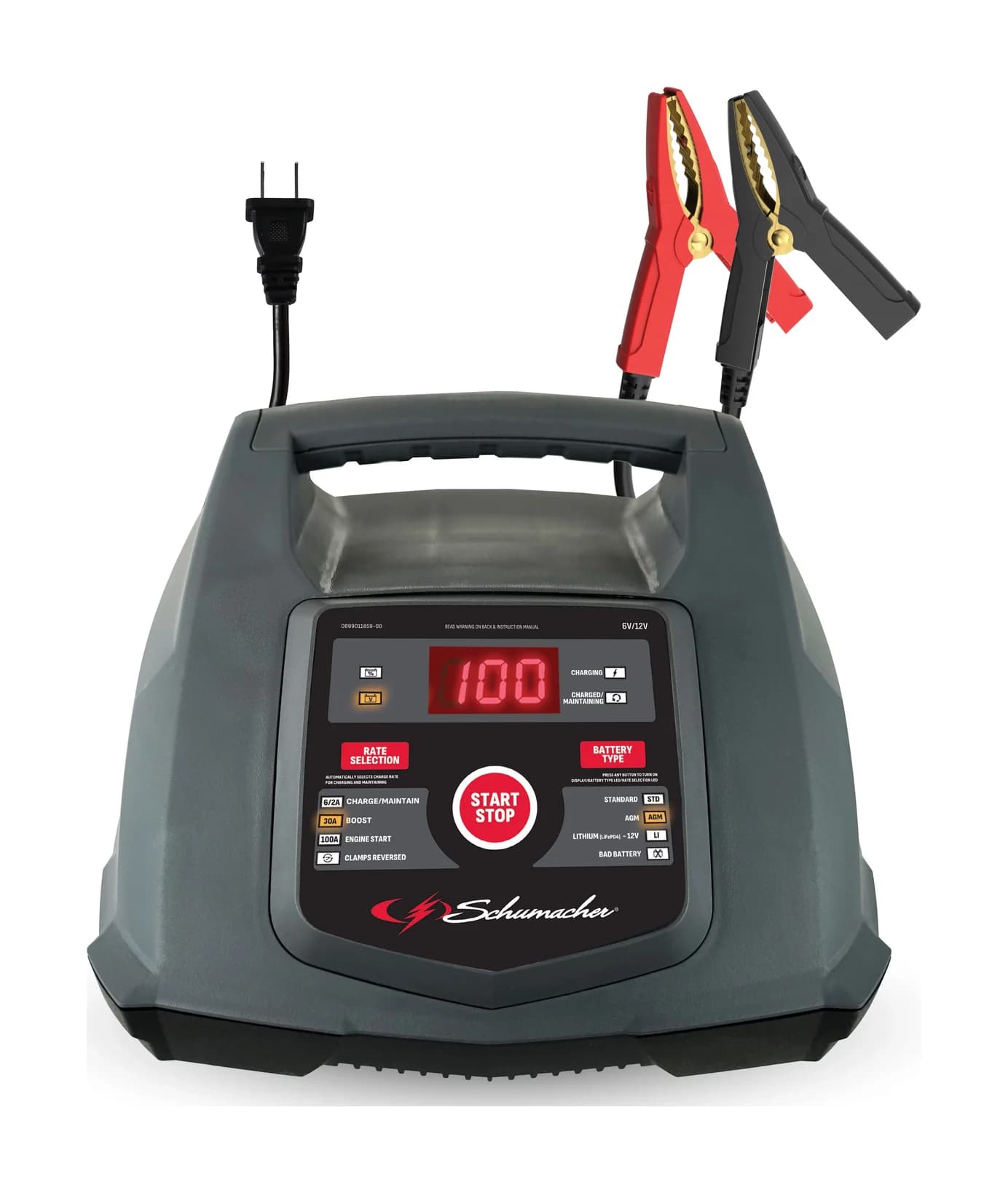
The Schumacher SC1281 is a 6V/12V plug-in smart charger with four distinct modes: 2A or 6A charging, a 12-30A boost mode for deeply discharged batteries, a 100A engine-start mode, and a desulfation mode. The engine-start mode works only while the unit is plugged into AC power — it is not a portable jump starter.
What the SC1281 covers that matters for this guide: the maker's own amp figures (with their labels), the engine-start requirement for AC power, and a chemistry list that appears two different ways on the same product page.
- 6AMaximum charging current
- 100AEngine-start output (while plugged in)
- 2/6/30/100AAll output modes, per the spec table
- 1 YearWarranty term
Schumacher SC1281: Schumacher Electric SC1281
Schumacher's spec table lists the output current as 2/6/30/100A. Each figure belongs to a different mode:
- 2A and 6A charging: The standard smart-charge range. The unit uses microprocessor-controlled multi-stage charging. The spec table gives no minimum start voltage and no stated Ah range.
- 12-30A boost: A higher-current charge mode for faster recovery of flat batteries. Schumacher calls it "12-amp to 30-amp boost charge" in the product description — but the spec table Output Current lists only 2/6/30/100A with no distinct 12-amp mode.
- 100A engine start: A cranking assist available only when the unit is plugged in. Schumacher states the SC1281 "must be plugged in during use" for engine start.
- Desulfation: Schumacher names a "battery reconditioning desulfation mode" but gives no current, cycle count or recovery claim for it.
Plug in
The unit auto-detects 6V or 12V batteries. It must be plugged in for all modes.
Connect to battery
Reverse polarity protection is listed; follow the manual's connection order.
Select mode
The unit selects the charge stage automatically in normal modes. Boost and engine start are selected manually.
Engine start
Available only while plugged in. The 100A output requires AC wall power.
The chemistry list — two versions on one page
Schumacher's SC1281 product page gives two different chemistry lists:
Product description: "supports both 6V and 12V batteries, including standard, AGM, deep-cycle, and 12V lithium (LiFePO4) battery types."
Spec table: "Battery Compatibility Type: AGM."
Report both. The spec table is the more restrictive version and is the one to check when you need confirmed compatibility. The broader list in the description cannot override it — the check flag asks readers to verify before relying on it. Lithium (LiFePO4) support counts only when the maker names it for this model, as the description does; the spec table's AGM-only listing means you should confirm with Schumacher before relying on it for a lithium battery.
Versions and what's in the box
The product page sells the unit as SC1281L in the box listing ("Includes (1) SC1281L 6A Battery Charger and Maintainer") and as SC1281 in the spec table. Same unit — the L appears only in the kit naming, not in the model designation itself.
Contents in the box: 1 SC1281 6A Car Battery Charger and 100A Engine Starter, and an owner's manual. The manual is the source for connection order, crank time and rest time limits.
What the maker does not state
The following are not listed on Schumacher's SC1281 product page or in the saved evidence:
- Battery Ah range: No minimum or maximum battery capacity the charger is rated for.
- Minimum start voltage: No voltage the charger can recover a battery from.
- Operating and charging temperatures: No temperature range for use or charging.
- Crank and rest times for engine start: No stated limit on cranking duration or rest between attempts. Point readers to the manual for this.
- IP rating: The spec table lists "No Rating."
Nearest alternatives and when to choose them
The alternatives that appear on Schumacher's own SC1281 product page are other Schumacher chargers. Here is how they differ:
Schumacher SC1281
- Charging amps
- 2A / 6A
- Engine start
- 100A
- Boost
- 12–30A
All specifications
- Desulfation
- yes
- Built-in tester
- battery + alternator
- Voltage
- 6V / 12V
- Warranty
- 1 Year
Schumacher SC1357
- Charging amps
- 2A / 6A
- Engine start
- —
- Boost
- —
All specifications
- Desulfation
- yes
- Built-in tester
- —
- Voltage
- 6V / 12V
- Warranty
- 1 Year
Schumacher SC1361
- Charging amps
- 2A / 6A
- Engine start
- 50A
- Boost
- 10A
All specifications
- Desulfation
- yes
- Built-in tester
- —
- Voltage
- 12V only
- Warranty
- 1 Year
Full comparison table
Swipe to compare. Row labels stay visible.
| Specification | Schumacher SC1281 | Schumacher SC1357 | Schumacher SC1361 |
|---|---|---|---|
| Charging amps | 2A / 6A | 2A / 6A | 2A / 6A |
| Engine start | 100A | — | 50A |
| Boost | 12–30A | — | 10A |
| Desulfation | yes | yes | yes |
| Built-in tester | battery + alternator | — | — |
| Voltage | 6V / 12V | 6V / 12V | 12V only |
| Warranty | 1 Year | 1 Year | 1 Year |
Scroll horizontally to see every column
| Specification | Schumacher SC1281 | Schumacher SC1357 | Schumacher SC1361 |
|---|---|---|---|
| Charging amps | 2A / 6A | 2A / 6A | 2A / 6A |
| Engine start | 100A | — | 50A |
| Boost | 12–30A | — | 10A |
| Desulfation | yes | yes | yes |
| Built-in tester | battery + alternator | — | — |
| Voltage | 6V / 12V | 6V / 12V | 12V only |
| Warranty | 1 Year | 1 Year | 1 Year |
Note on the comparison table: Engine-start and boost figures for SC1361 are confirmed from its own product page (50A engine start, 10A boost). SC1357 has no engine-start or boost mode — the "—" entries for both are cross-referenced from the SC1281 page and match what Schumacher's SC1357 page describes (3-in-1, no engine start mentioned).
Choose the SC1281 if you need engine-start capability in a plugged-in charger and want both a battery tester and an alternator tester. The 12-30A boost mode is useful for deeply discharged batteries that still hold a surface charge.
Choose the SC1357 if you need a charger-maintainer without engine start or boost; it matches the SC1281 on charging amps and desulfation. Choose the SC1361 if you want engine-start capability in a 12V-only unit: the SC1361 lists 50A engine start and 10A boost in its spec table. Neither the SC1357 nor the SC1361 has a confirmed built-in tester.
For a charger-maintainer without engine start but with a wider chemistry list, look at a different maker's own pages — the NOCO GENIUS series is common in this tier and lists seven chemistry types in its spec table.
Limits and warnings (from the manual)
Schumacher's product description includes the features and certifications but the owner's manual is the source for connection order, crank time, rest time between attempts, and any force-start procedure. Point readers to the manual before use.
How we choose
We read each maker's own product page, spec table and warranty statement. Where pages disagree — as Schumacher's description and spec table do on chemistry — we report both and note the conflict. We never open retailer pages for evidence. Every figure above traces to a source in the product record.
Verdict
The Schumacher SC1281 earns its place as a garage charger that does more than a basic maintainer: 6A charging, 12-30A boost, 100A engine-start assist (while plugged in), desulfation, and a battery-and-alternator tester all in one unit. The engine-start figure requires AC power, which separates it from every portable jump starter on the market.
The chemistry conflict between description and spec table is the main caveat: if you are charging a lithium (LiFePO4) or standard lead-acid battery, verify compatibility against the spec table first. The manual is the source for any crank time and rest time limits that the product page does not state.
See our guide to portable car battery chargers for the broader category, and how this unit's engine-start mode differs from a battery charger and jump starter in one.
Frequently asked questions
Is the Schumacher SC1281 a jump starter?
No, and the difference matters. A jump starter has an internal battery and starts a car anywhere. The SC1281's 100A engine-start mode only works while the unit is plugged into AC power — it cannot start a car away from a wall outlet. Engine-start amps on a plug-in charger are not a portable jump starter's peak amps, and the two figures are never comparable.
What chemistries does the SC1281 charge?
Here the maker's own pages disagree. The product description says it handles 'standard, AGM, deep-cycle, and 12V lithium (LiFePO4)' batteries. The spec table lists only 'Battery Compatibility Type: AGM.' Report both: if you need lithium or standard lead-acid confirmation, check the spec table first — it is the more restrictive version.
What does the SC1281's engine-start mode require?
AC power. Schumacher states the unit 'must be plugged in during use' for engine start. The 100A figure is not a portable jump starter's peak rating; it is a sustained output available only while the charger draws wall power. Never compare the two.
How fast does the SC1281 charge a car battery?
The maker gives no charge time figures, no Ah range for the batteries it can charge, and no minimum start voltage it recovers from. The highest charging current is 6A. Charge speed depends on the battery's capacity and condition — Schumacher states neither a maximum battery size nor a recovery range.
What safety features does the SC1281 have?
Schumacher lists reverse polarity protection and automatic shutoff in the product description. The spec table lists: UL Listed (File: E32074, UL Model: 102-8), cETLus, DOE and FCC. No IP rating is stated. The manual is the source for any crank time, rest time, or connection order instructions.
How long is the warranty?
One year, per the maker's warranty page.
Related guides
Best picks · Car Battery Chargers
Battery Charger and Jump Starter in One: Plug-In Chargers with Engine Start
Compare plug-in battery chargers with engine-start modes and charge-and-start combos. What each maker says it does, how it starts an engine, and which ones need a wall outlet.
Explainer · Car Battery Chargers
Portable Car Battery Chargers Explained: Charger, Maintainer or Jump Starter?
The three devices that share 'portable car battery charger' cover different jobs. This guide sorts them out using each maker's own published figures and engine ratings.