

Explainer
Portable Car Battery Chargers Explained
Charger, Maintainer or Jump Starter?
The three devices that share 'portable car battery charger' cover different jobs. This guide sorts them out using each maker's own published figures and engine ratings.
By thisJOLT EditorialUpdated November 17, 202611 min read
On this page · The three approaches at a glance
Warnings and sources
Jump starters, battery chargers and compressors involve high current, battery gases, heat and pressure. Follow the maker’s manual for the exact model and your vehicle’s owner’s manual; this guide summarizes published specifications and is not a set of instructions.
Three different kinds of device show up when you search for a "portable car battery charger." One lives in the glovebox and starts engines from its own battery. Another is a self-contained booster that can revive a dead battery in minutes without a wall socket. A third is a small plug-in unit you leave connected through the winter. All three fit the search — and all three do different jobs.
The buying decision this page settles is which one matches your situation, using each maker's own published figures.
The three approaches at a glance
- Lithium jump packSelf-contained; rated in peak amps; rated for gas and diesel engine sizes
- Adaptive boosterSelf-contained; rated in time (starts a battery in minutes); needs recharging itself
- Plug-in charger/maintainerNeeds wall outlet; rated by charging current; designed for hours of connection
Lithium jump packs carry their own battery and deliver a burst of starting power the moment you connect them — the maker rates the unit by its peak starting current (in amps) and by the gas and diesel engine sizes it can handle. They live in a trunk kit.
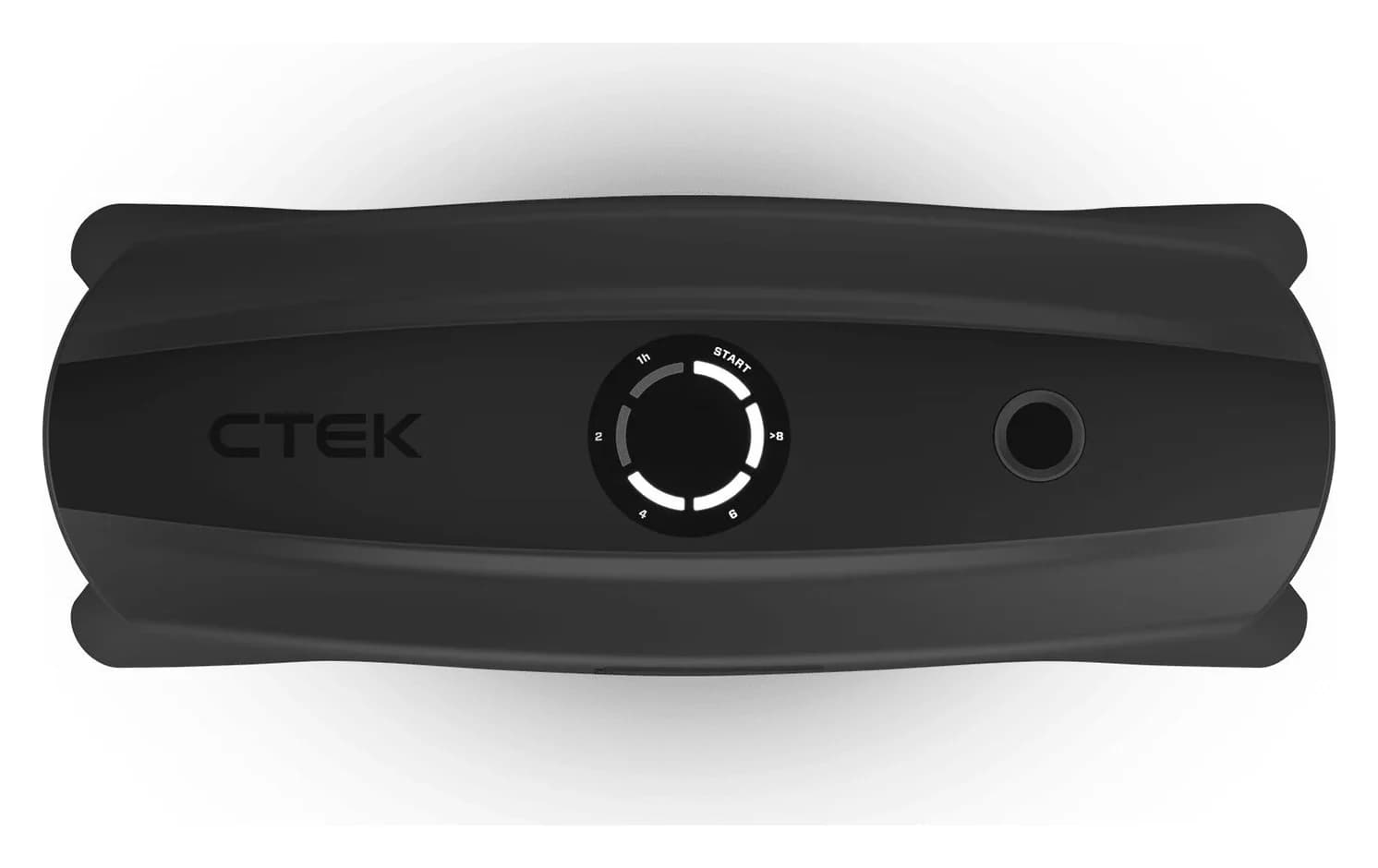
Adaptive boosters also carry their own battery but are rated by how quickly they can revive a dead battery — CTEK says the CS FREE "starts any 12V battery in 15 mins." They work without a wall outlet and double as power banks.
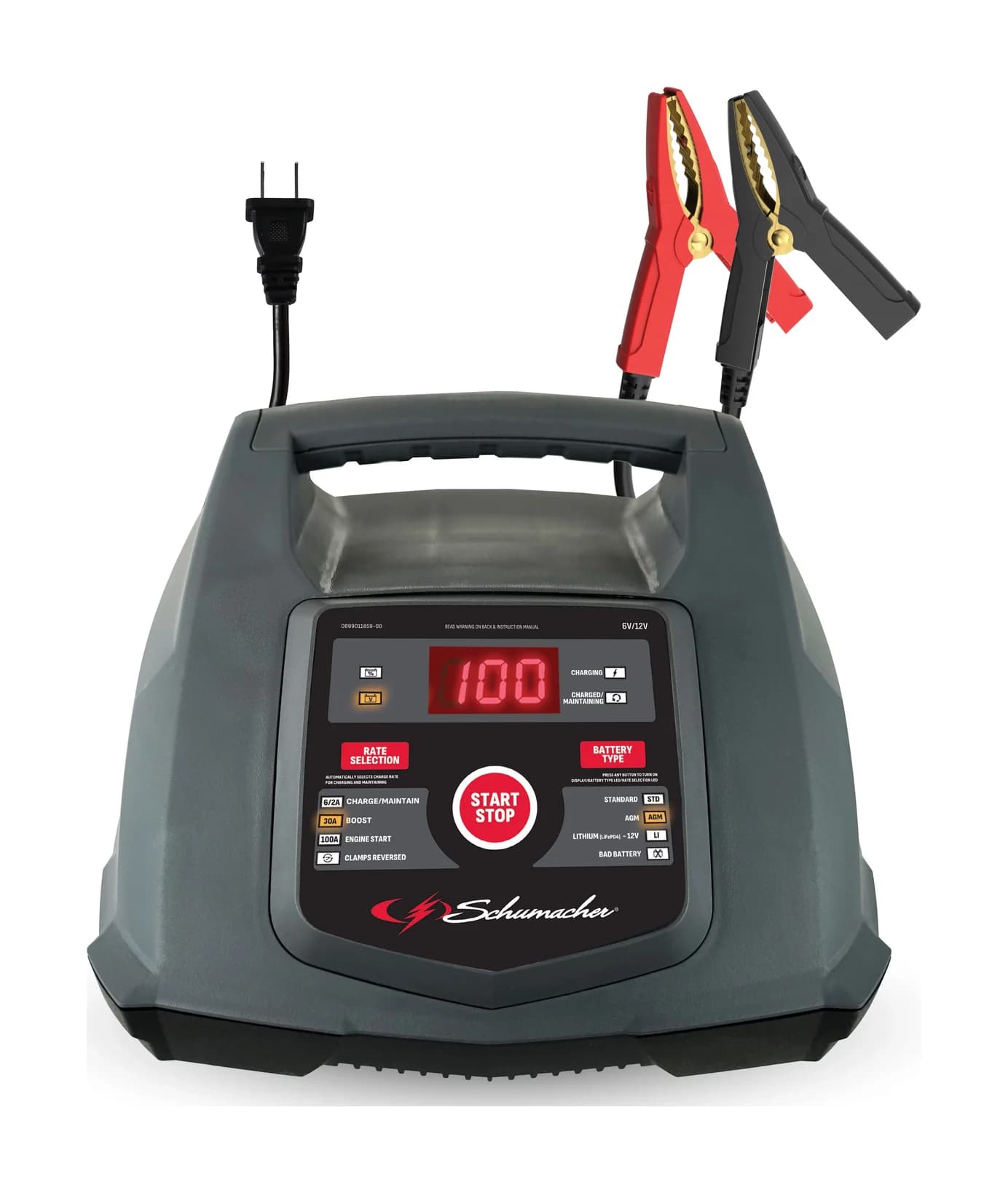
Plug-in chargers and maintainers need AC power. A smart charger such as the Schumacher SC1281 charges a flat battery and can deliver a high-amperage engine start when it is plugged in. A maintainer such as the Battery Tender Junior is sized for long-term, unsupervised connection — Battery Tender says "you can leave it connected for months without any concern."
How lithium jump packs and adaptive boosters are rated differently
A lithium jump pack and a battery-powered booster both carry their own internal battery — but the two product types rate themselves in fundamentally different ways.
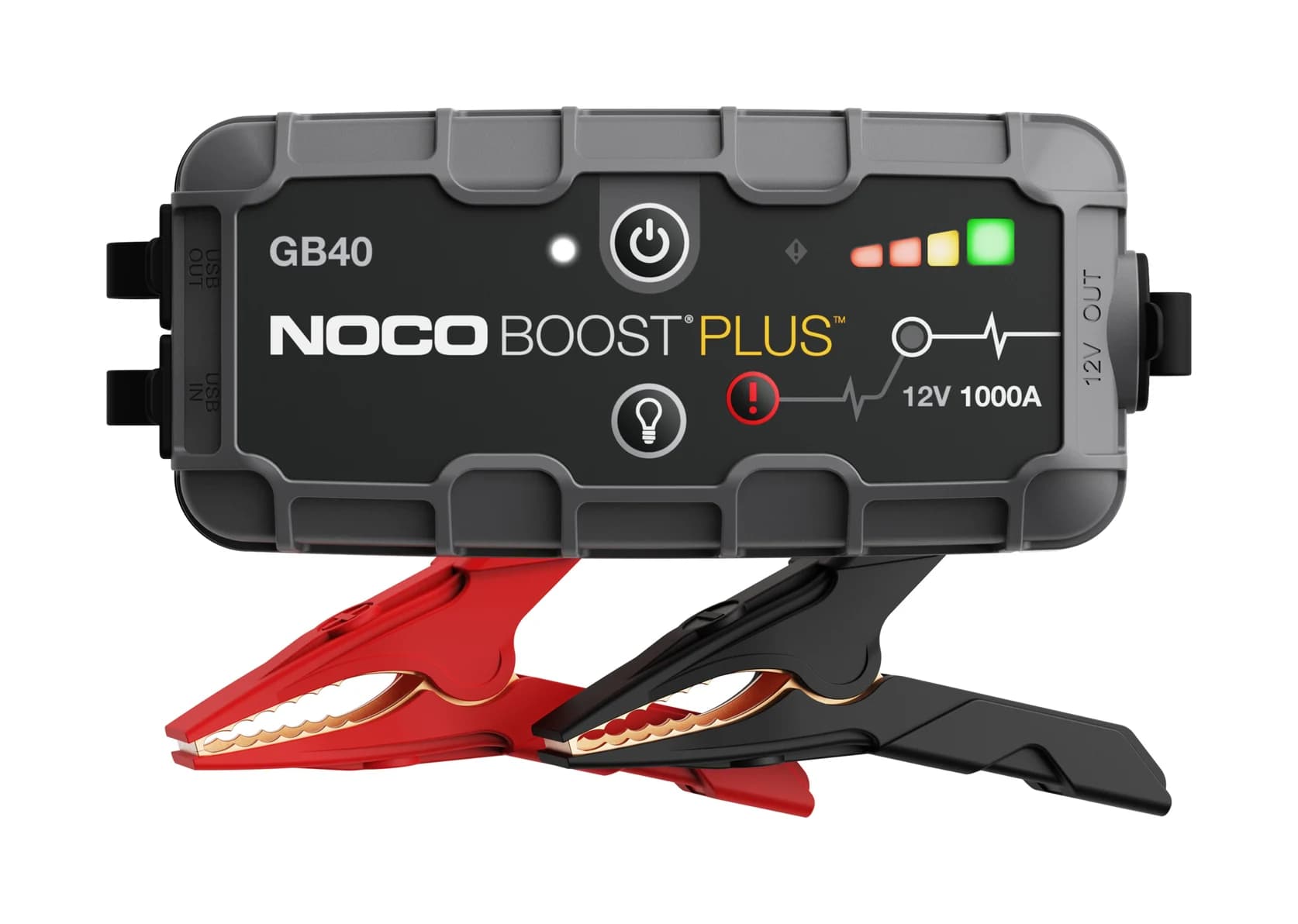
NOCO rates the GB40 jump pack by its starting current: "1000 Amps (Peak)" from a battery that stores 24 watt-hours. The peak amp figure describes a brief maximum current pulse, and the watt-hours figure describes the total energy stored — two different measurements.
CTEK describes the CS FREE adaptive booster in time: CTEK's page says the unit revives a dead 12V battery within a stated 15-minute window, and its countdown "shows you when you have enough power to start the vehicle." CTEK prints no peak or cranking amps for the CS FREE, and never compares its time-based rating to a jump pack's amp rating. Comparing a peak-amp figure to a time-based claim puts two different things in the same sentence, which is why the two are presented side by side here, not ranked against each other.
What the makers' figures do — and do not — say
Because the two device types use different rating systems, a few spec-label distinctions matter:
Peak amps are not cranking amps. NOCO's GB40 is rated at "1000 Amps (Peak)" in its spec table. A figure labeled cranking amps (CA) or cold cranking amps is a different measurement under different test conditions — and none of those figures is comparable to a battery charger's engine-starting current, which comes from a wall outlet.
Watt-hours describe stored energy, not starting power. NOCO's spec sheet lists "24 Watt-Hour Lithium-Ion." Watt-hours measure how much total energy the internal battery holds; peak amps measure the burst current it can deliver. A higher Wh pack is not automatically a more powerful jump starter.
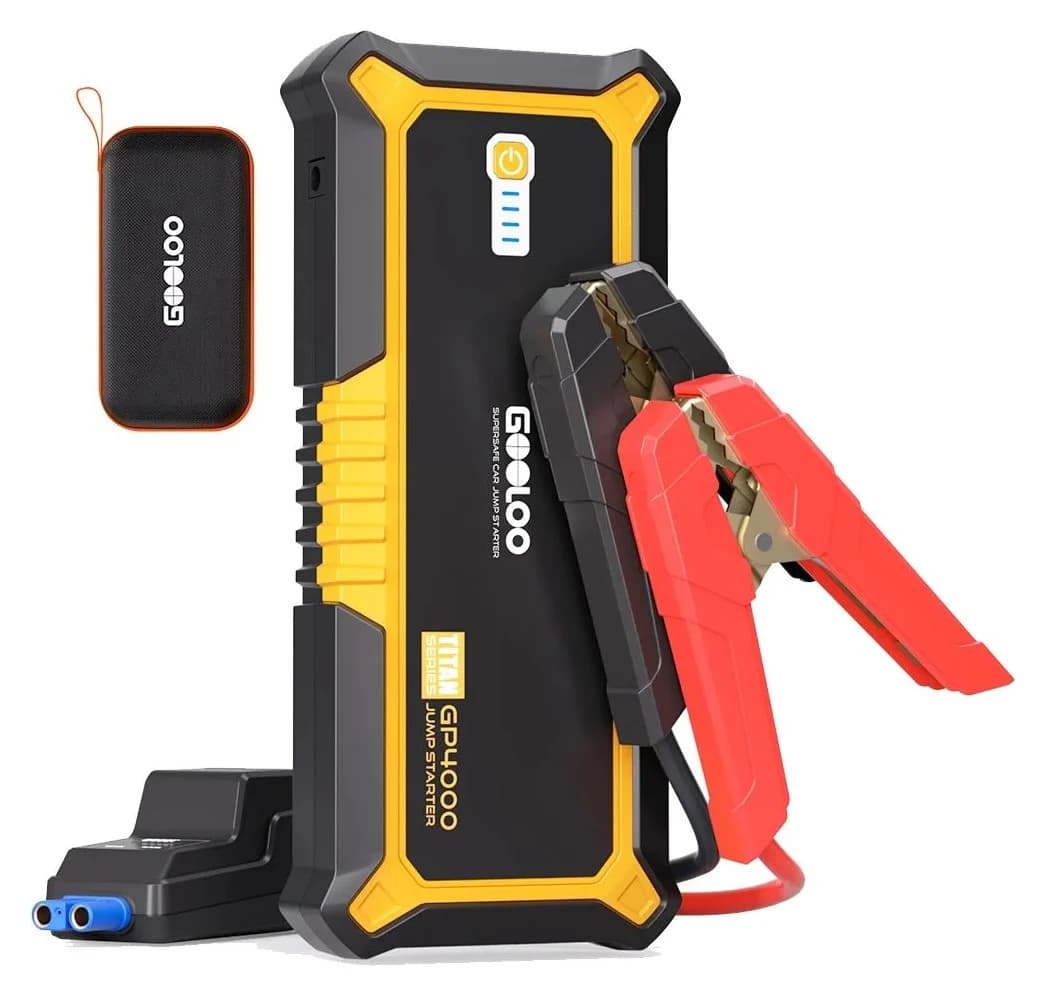
Engine ratings are quoted, never derived. GOOLOO rates the GP4000 for "12V gas and diesel up to 10.0L" — one figure for both fuels. NOCO rates the GB40 separately: gas "Up to 6.0 Liters" and diesel "Up to 3.0 Liters." When a maker gives one rating for both, that rating is used verbatim; it is never split or converted into separate gas and diesel figures.
Jump packs: self-contained starting power
A lithium jump pack is a compact device you store in the vehicle. When the battery is dead, you connect the clamps, wait for the indicator, and start the engine. The pack has its own battery that you recharge separately between uses.
Example: NOCO GB40
NOCO rates the GB40 at "1000 Amps (Peak)" from a battery rated at 24 watt-hours, for gas engines "Up to 6.0 Liters" and diesel "Up to 3.0 Liters." NOCO states an IP rating of IP65, a "1 Year Hassle-Free Warranty," and a USB output of "5 Volts 2.1 Amps Max."
The spec sheet does not state cranking amps, starts per charge, clamp cable gauge, safety listing, or operating temperature range.
Example: GOOLOO GP4000
GOOLOO describes the GP4000 as delivering "4000A of JUMPCORE starting power" — a 4,000-amp peak — with a "lithium polymer battery" and an engine rating of "12V gas and diesel up to 10.0L." GOOLOO states "one full charge delivers 60+ jump starts" and a warranty of "Up To 30 Months Warranty."
GOOLOO lists operating and storage temperatures of "-20°C to 60°C (-4°F to 140°F)", and a "24-month standby" claim meaning the unit holds enough charge to start after two years of sitting unused. The spec sheet does not state cranking amps, internal battery watt-hours, mAh capacity, cable length or gauge, weight, IP rating, or a formal safety listing.
GOOLOO also includes a maker warning: "If the ambient temperature is above 60°C (140°F), the internal cell construction of the lithium polymer battery may be damaged, causing it to swell and become unsafe. Do not store the device in a vehicle parked in hot weather for long periods of time."
GOOLOO's product page marketing bullet says "10-layer SUPERSAFE protection" while the FAQ section lists "8 protection features" with only four named types (over-current, overload, over-voltage, overcharge). The article records the FAQ figure of 8 protection features as the authoritative count.
Adaptive boosters: self-contained, time-rated revival
An adaptive booster such as the CTEK CS FREE is also self-contained — it has its own internal battery — but the maker describes it in terms of how long it takes to get a battery to a startable state, rather than how many peak amps it can push. It is also usable as a power bank and can be recharged from USB-C or an optional solar panel.
Example: CTEK CS FREE
CTEK describes the CS FREE as an "Adaptive Booster" that revives a dead 12V battery within a stated 15-minute window. CTEK prints no peak or cranking amps for it. Its internal battery is "66 Wh" of "Polymer Lithium-Ion," rated for "300 cycles, 80%" of capacity. The minimum start voltage is "3.0 V," and the battery capacity the unit works with is "10–130 Ah." Battery types listed are "12 V, WET, MF, Ca/Ca, AGM, EFB, GEL, LiFePO₄" and the battery chemistry range is "Lead acid, Lithium-ion." The ambient operating temperature range is "-20 ˚C to +50 ˚C (- 4 °F to +122 °F)," the IP rating is IP54, and the warranty is "2 years."
The spec sheet states a maximum output of "12 V,20 A/240 W max." It does not state an engine-start mode, safety listing, or protections.
Plug-in chargers and maintainers: wall-powered, time on your side
A plug-in charger or maintainer needs an AC outlet. A smart charger recovers a flat battery by feeding it controlled current over time; a maintainer is designed to stay connected for months without supervision. Both do their work from wall power, not from an internal battery.
Example: Schumacher Electric SC1281
The Schumacher SC1281 supports "both 6V and 12V batteries" with a "2A to 6A charge" (maximum charging current 6A) and multiple modes: "100-amp engine start, 30-amp to 12-amp boost charging, 6-amp to 2-amp charging, and smart trickle charge." Schumacher states its chemistry support differs between its description ("standard, AGM, deep-cycle, and 12V lithium (LiFePO4)") and its spec table ("Battery Compatibility Type: AGM") — both versions are recorded. The unit is "UL Listed, File: E32074, UL Model: 102-8, cETLus Listed, DOE, FCC" and carries a "1 Year" warranty. Weight is "10 lb."
The unit "must be plugged in during use" for all functions including engine start. The spec sheet does not state a battery size range the unit is rated for, a minimum start voltage, or operating temperature range.
Example: Battery Tender Junior 021-0123
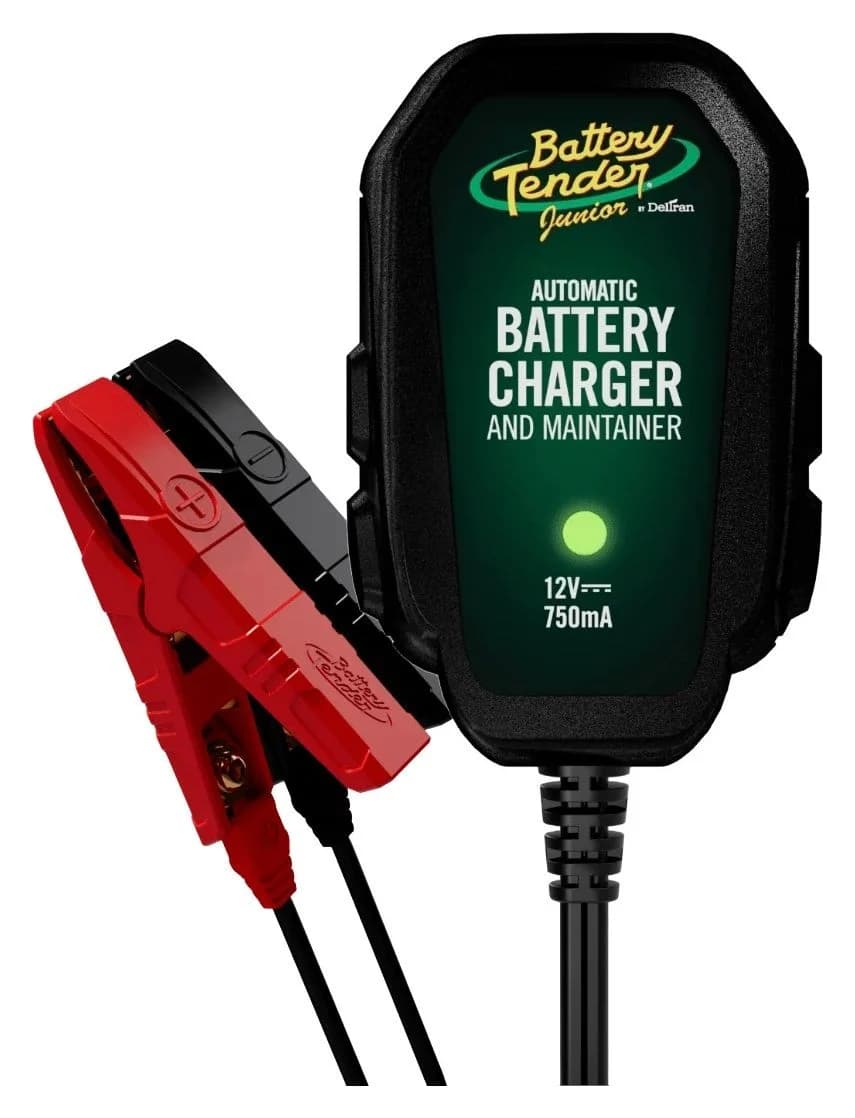
The Battery Tender Junior is a fully automatic 12V charger and maintainer with a bulk output of "12V @ 750 mA" (the spec block also lists "Output Current Range: 0 - 2 AMPs" — both figures are recorded). It works with "AGM, GEL, Standard (Sealed or Flooded Lead Acid)" batteries (Battery Tender's product page also separately lists "Flooded (wet cell) — Traditional lead-acid batteries requiring ventilation," indicating the Standard row covers both sealed and flooded lead-acid types) and is rated for "3Ah to 30Ah at 12V" (Battery Tender's FAQ notes that for "standard passenger cars and trucks (typically 35–100Ah), the Junior will fully maintain a charged battery during storage" but that a higher-output model is recommended for recovering deeply discharged car batteries). The unit carries ETL & CETL FCC, ICES, CEC, DOE certifications per the spec sheet and a "5 Years" warranty.
Battery Tender states the Junior "operates effectively in temperatures from 5°F to 122°F (-15°C to 50°C)" and says the maker's four-stage ISM algorithm means "you can leave it connected for months without any concern." Battery Tender's warning word for word: "never attempt to charge a visibly frozen battery. If your battery has frozen solid (you can hear electrolyte crackling when moved), let it thaw completely at room temperature first, then connect the charger."
Battery Tender's spec sheet does not state an IP rating or maximum charging current.
How the makers rate each device type
NOCO GB40
- Type
- Jump pack
- Self-contained?
- Yes
- Starting rating
- 1000 Amps (Peak)
All specifications
- Battery voltage
- 12 Volt
- Battery chemistries
- 12 Volt Lead-Acid
- Gas engine rating
- Up to 6.0 Liters
- Diesel engine rating
- Up to 3.0 Liters
- Internal battery
- 24 Watt-Hour Lithium-Ion
- Safety listing
- Not stated
- IP rating
- IP65
- Warranty
- 1 Year
GOOLOO GP4000
- Type
- Jump pack
- Self-contained?
- Yes
- Starting rating
- 4000A JUMPCORE starting power
All specifications
- Battery voltage
- 12V
- Battery chemistries
- Gel listed in FAQ ("as long as it is at 12 Volt")
- Gas engine rating
- 12V gas and diesel up to 10.0L
- Diesel engine rating
- 12V gas and diesel up to 10.0L
- Internal battery
- lithium polymer
- Safety listing
- Not stated
- IP rating
- Not stated
- Warranty
- Up To 30 Months
CTEK CS FREE
- Type
- Adaptive booster
- Self-contained?
- Yes
- Starting rating
- Time-based (revs a dead 12V battery in 15 mins)
All specifications
- Battery voltage
- 12 V
- Battery chemistries
- WET, MF, Ca/Ca, AGM, EFB, GEL, LiFePO₄
- Gas engine rating
- Not stated
- Diesel engine rating
- Not stated
- Internal battery
- 66 Wh Polymer Lithium-Ion
- Safety listing
- Not stated
- IP rating
- IP54
- Warranty
- 2 years
Schumacher SC1281
- Type
- Plug-in charger
- Self-contained?
- No (AC required)
- Starting rating
- 100-amp engine start (AC powered)
All specifications
- Battery voltage
- 6V and 12V
- Battery chemistries
- Spec table: AGM; description: standard, AGM, deep-cycle, 12V lithium (LiFePO4)
- Gas engine rating
- Not applicable
- Diesel engine rating
- Not applicable
- Internal battery
- None (AC powered)
- Safety listing
- UL Listed (File: E32074, UL Model: 102-8); DOE; FCC
- IP rating
- No Rating
- Warranty
- 1 Year
Battery Tender Junior
- Type
- Plug-in maintainer
- Self-contained?
- No (AC required)
- Starting rating
- 750 mA bulk output
All specifications
- Battery voltage
- 12V
- Battery chemistries
- AGM, GEL, Standard (Sealed or Flooded Lead Acid)
- Gas engine rating
- Not applicable
- Diesel engine rating
- Not applicable
- Internal battery
- None (AC powered)
- Safety listing
- ETL & CETL FCC, ICES, CEC, DOE
- IP rating
- Not stated
- Warranty
- 5 Years
Full comparison table
Swipe to compare. Row labels stay visible.
| Specification | NOCO GB40 | GOOLOO GP4000 | CTEK CS FREE | Schumacher SC1281 | Battery Tender Junior |
|---|---|---|---|---|---|
| Type | Jump pack | Jump pack | Adaptive booster | Plug-in charger | Plug-in maintainer |
| Self-contained? | Yes | Yes | Yes | No (AC required) | No (AC required) |
| Starting rating | 1000 Amps (Peak) | 4000A JUMPCORE starting power | Time-based (revs a dead 12V battery in 15 mins) | 100-amp engine start (AC powered) | 750 mA bulk output |
| Battery voltage | 12 Volt | 12V | 12 V | 6V and 12V | 12V |
| Battery chemistries | 12 Volt Lead-Acid | Gel listed in FAQ ("as long as it is at 12 Volt") | WET, MF, Ca/Ca, AGM, EFB, GEL, LiFePO₄ | Spec table: AGM; description: standard, AGM, deep-cycle, 12V lithium (LiFePO4) | AGM, GEL, Standard (Sealed or Flooded Lead Acid) |
| Gas engine rating | Up to 6.0 Liters | 12V gas and diesel up to 10.0L | Not stated | Not applicable | Not applicable |
| Diesel engine rating | Up to 3.0 Liters | 12V gas and diesel up to 10.0L | Not stated | Not applicable | Not applicable |
| Internal battery | 24 Watt-Hour Lithium-Ion | lithium polymer | 66 Wh Polymer Lithium-Ion | None (AC powered) | None (AC powered) |
| Safety listing | Not stated | Not stated | Not stated | UL Listed (File: E32074, UL Model: 102-8); DOE; FCC | ETL & CETL FCC, ICES, CEC, DOE |
| IP rating | IP65 | Not stated | IP54 | No Rating | Not stated |
| Warranty | 1 Year | Up To 30 Months | 2 years | 1 Year | 5 Years |
Scroll horizontally to see every column
| Specification | NOCO GB40 | GOOLOO GP4000 | CTEK CS FREE | Schumacher SC1281 | Battery Tender Junior |
|---|---|---|---|---|---|
| Type | Jump pack | Jump pack | Adaptive booster | Plug-in charger | Plug-in maintainer |
| Self-contained? | Yes | Yes | Yes | No (AC required) | No (AC required) |
| Starting rating | 1000 Amps (Peak) | 4000A JUMPCORE starting power | Time-based (revs a dead 12V battery in 15 mins) | 100-amp engine start (AC powered) | 750 mA bulk output |
| Battery voltage | 12 Volt | 12V | 12 V | 6V and 12V | 12V |
| Battery chemistries | 12 Volt Lead-Acid | Gel listed in FAQ ("as long as it is at 12 Volt") | WET, MF, Ca/Ca, AGM, EFB, GEL, LiFePO₄ | Spec table: AGM; description: standard, AGM, deep-cycle, 12V lithium (LiFePO4) | AGM, GEL, Standard (Sealed or Flooded Lead Acid) |
| Gas engine rating | Up to 6.0 Liters | 12V gas and diesel up to 10.0L | Not stated | Not applicable | Not applicable |
| Diesel engine rating | Up to 3.0 Liters | 12V gas and diesel up to 10.0L | Not stated | Not applicable | Not applicable |
| Internal battery | 24 Watt-Hour Lithium-Ion | lithium polymer | 66 Wh Polymer Lithium-Ion | None (AC powered) | None (AC powered) |
| Safety listing | Not stated | Not stated | Not stated | UL Listed (File: E32074, UL Model: 102-8); DOE; FCC | ETL & CETL FCC, ICES, CEC, DOE |
| IP rating | IP65 | Not stated | IP54 | No Rating | Not stated |
| Warranty | 1 Year | Up To 30 Months | 2 years | 1 Year | 5 Years |
Common mix-ups this page settles
"Peak amps" vs. "cranking amps." A jump pack rated at "1000 Amps (Peak)" delivers a brief maximum pulse. Cranking amps and cold cranking amps are measured differently and mean different things. Never compare a peak rating to a cranking amp figure, and never set a jump starter's peak rating against a car battery's CCA label.
"Jump starter" vs. "engine-start mode on a charger." The Schumacher SC1281 has a "100-amp engine start" — but it must be plugged into 120V AC to work. That is not a jump pack. A jump pack starts a car from its own internal battery with no outlet nearby.
"Charger" vs. "maintainer." A maintainer such as the Battery Tender Junior is designed for long-term unsupervised connection and has a maximum charging current of 2 amps or less. A charger such as the Schumacher SC1281 delivers up to 6A and is intended for battery recovery over hours. The two have different use cases: one prevents discharge during storage, the other recovers a flat battery for use.
mAh and Wh are not interchangeable. GOOLOO does not state a Wh or mAh figure for the GP4000; CTEK states "66 Wh" for the CS FREE's internal battery. Never calculate Wh from an unstated mAh figure, and never present a Wh or mAh number as evidence of starting power.
Engine ratings are not derived from amp numbers. GOOLOO's "12V gas and diesel up to 10.0L" and NOCO's separate gas "Up to 6.0 Liters" / diesel "Up to 3.0 Liters" are the makers' own figures, quoted verbatim. Never derive a gas or diesel rating from a peak-amp number or a model name.
Which device type is right for you
Choose a lithium jump pack if you want a device stored in the vehicle that can start the engine immediately when the battery is dead. It needs no wall outlet, delivers peak amps, and is ready within seconds of connecting. Recharge it between uses.
Choose an adaptive booster if you want a self-contained device that can revive a dead battery without a wall outlet but also restore enough charge to drive away — CTEK says the CS FREE reaches a startable state in 15 minutes and can also work as a power bank. It does not have a peak-amp rating.
Choose a plug-in charger if you are at a location with an outlet and need to recover a flat battery over time, or want the option of an engine-start mode from a wall-powered unit (the Schumacher SC1281's 100-amp engine start, "must be plugged in during use").
Choose a maintainer if the device's job is keeping a battery topped up through weeks or months of storage — Battery Tender says of the Junior, "you can leave it connected for months without any concern."
For jump starters compared by the engine sizes their makers name, see the site's jump starter guide. For plug-in chargers matched to battery chemistry, see the charger comparison. For a jump starter that also fills tires, see the jump starter with air compressor picks.
Frequently asked questions
What is a portable car battery charger?
It depends on which device the search lands on. A lithium jump pack is a self-contained power bank for an engine jump — the maker rates it in peak amps. An adaptive booster such as the CTEK CS FREE is also self-contained but rated by time: CTEK says it revives a dead 12V battery within a stated window without a wall outlet. A plug-in charger or maintainer needs AC power and works by replenishing the battery's charge over time. The three do different jobs, and none of them is a shortcut for another.
What is the difference between a jump starter and a battery charger?
A jump starter provides a burst of power to turn the engine over immediately — the maker's figures are peak amps and engine size. A battery charger restores a discharged battery by feeding it current over minutes or hours — it has a charging current rating in amps and needs to be connected long enough to do its work. The Schumacher SC1281's 100-amp engine start requires a wall outlet the whole time it is running, and a jump pack needs no outlet at all.
Can a battery maintainer charge a dead battery?
A maintainer such as the Battery Tender Junior is designed to sit connected for weeks or months at a time, keeping a battery that has surface charge. Battery Tender states that batteries discharged to 2V–11.9V will typically begin accepting charge within 5–15 minutes of connection, but a deeply discharged battery left at near 0V for an extended period may have sulfation damage that no charger can reverse. The maintainer's job is prevention, not recovery from a dead battery.
What does 'peak amps' mean on a jump starter?
Peak amps is the maximum current the internal battery can deliver in a brief pulse — NOCO labels the GB40 at '1000 Amps (Peak)'. A label that says cranking amps, measured at a defined temperature, and one that says cold cranking amps, measured at a colder temperature, are each measured under their own conditions and are therefore never interchangeable with each other or with a peak-amp rating. The peak rating tells you the maximum the pack can put out, not the current it holds or how many starts it can deliver.
What is an adaptive booster like the CTEK CS FREE?
CTEK describes the CS FREE as an 'Adaptive Booster' that revives a dead 12V battery within a stated 15-minute window from its own internal battery, without needing a wall outlet. CTEK prints no peak or cranking amps for it; instead it lists a minimum start voltage of 3.0V and a battery capacity of 10–130 Ah. Its rating is time-based, not amp-based, which puts it in a separate category from both a jump pack and a plug-in charger.
Related guides
Best picks · Car Battery Chargers
Battery Charger and Jump Starter in One: Plug-In Chargers with Engine Start
Compare plug-in battery chargers with engine-start modes and charge-and-start combos. What each maker says it does, how it starts an engine, and which ones need a wall outlet.
Buying guide · Car Battery Chargers
Schumacher SC1281 Review: 6V/12V Charger with 100A Engine Start, Explained
What Schumacher's SC1281 6V/12V plug-in charger does in each mode, its chemistry-list discrepancy, and why its engine-start amps need AC power.