

Best picks
Battery Charger and Jump Starter in One
Plug-In Chargers with Engine Start
Compare plug-in battery chargers with engine-start modes and charge-and-start combos. What each maker says it does, how it starts an engine, and which ones need a wall outlet.
By thisJOLT EditorialUpdated November 17, 202613 min read6 picks
On this page · The short answer
The short answer
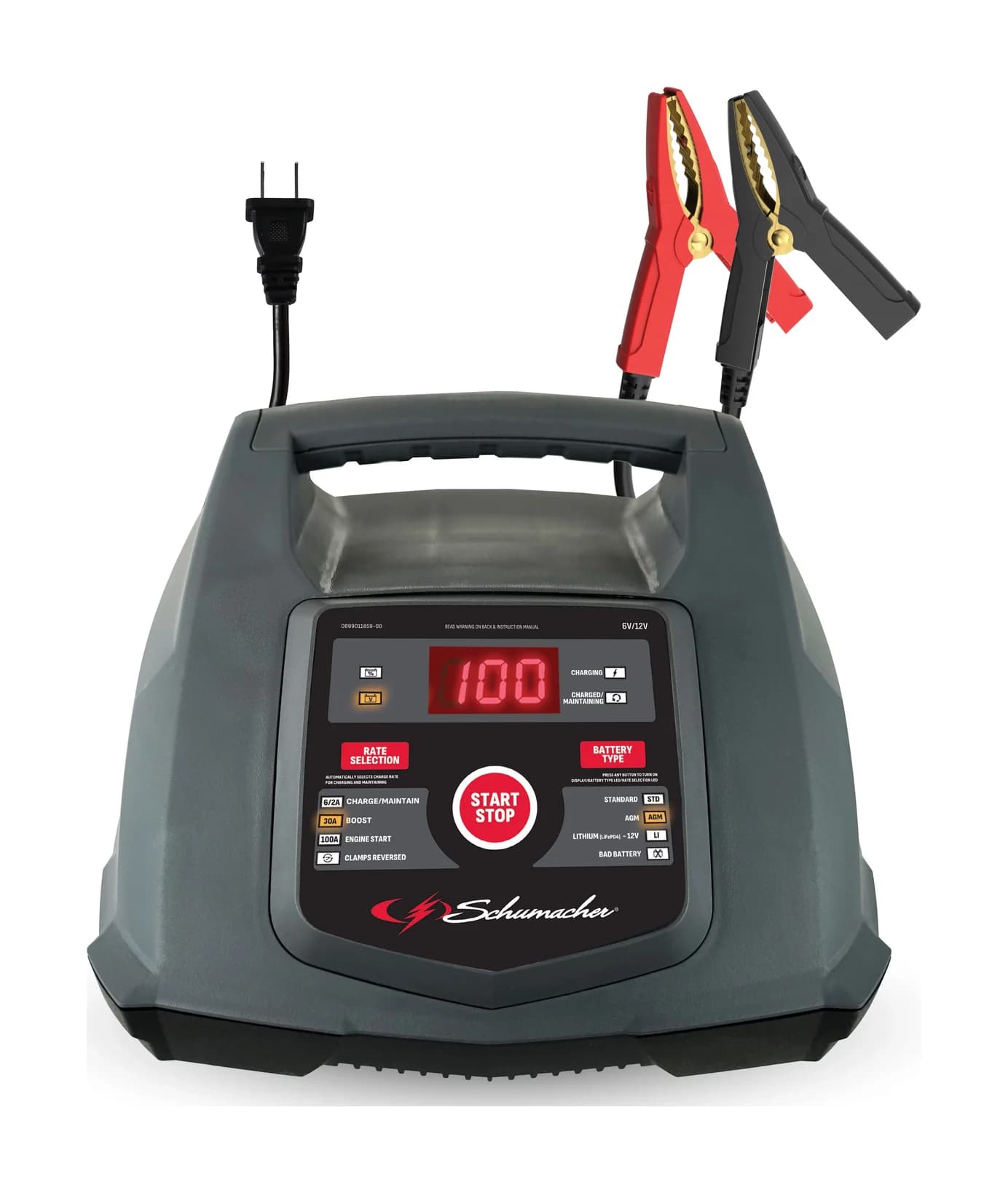
Schumacher Electric · SC1281
Schumacher Electric SC1281
- Battery voltages it charges
- 6V, 12V
- Highest charging current (maker)
- 6 A
- Battery types it lists
- AGM
- (spec table); standard, AGM, deep-cycle, and 12V lithium (LiFePO4) (description)
- Choose
- Best plug-in charger with engine start
- Check
- Engine-start mode requires AC power; unit must be plugged in during use per the maker — it does not jump-start away from a wall outlet
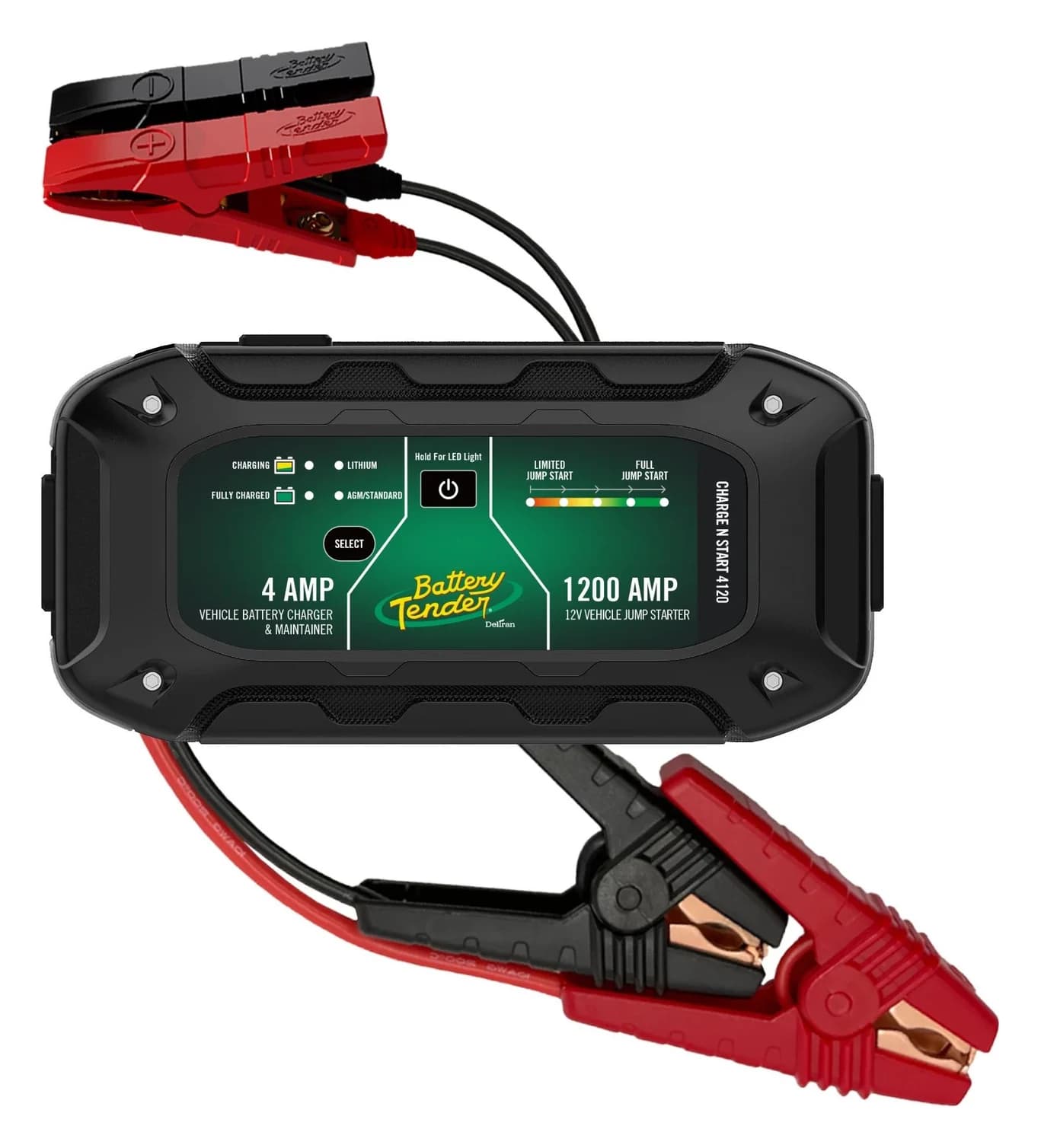
Battery Tender · 4120
Battery Tender 4120
- Battery voltages it charges
- 12V
- Highest charging current (maker)
- 4 A
- Battery sizes it is rated for (Ah)
- 14Ah to 100Ah at 12V
- Choose
- Best charge-and-start for the money
- Check
- Sold out status indicates limited availability
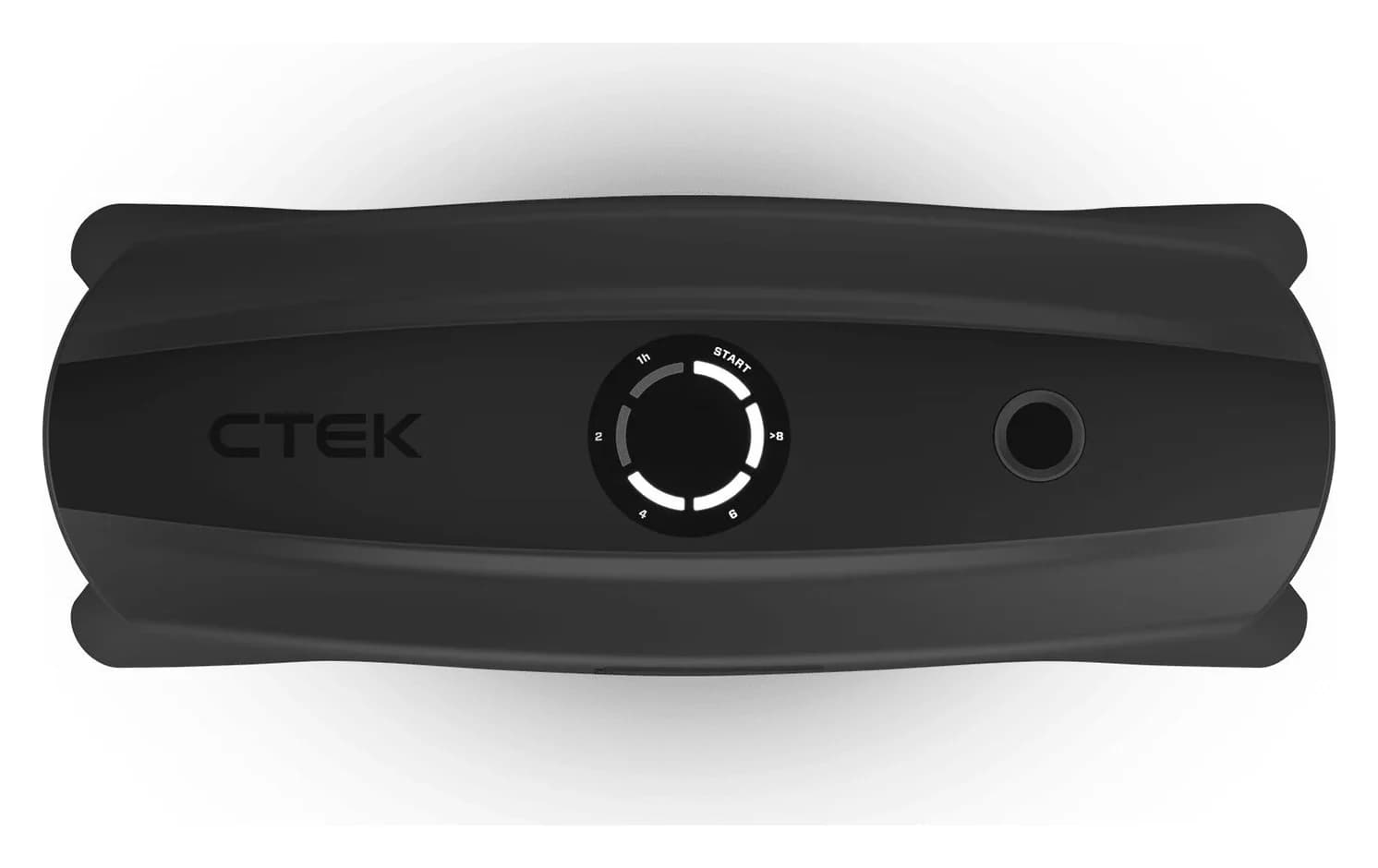
CTEK · 40-462
CS FREE Adaptive Booster
- Battery voltages it charges
- 12 V
- Battery sizes it is rated for (Ah)
- 10-130 Ah
- Minimum battery voltage it starts on
- Start voltage: 3.0 V
- Choose
- Best standalone option for no-wall-outlet situations
- Check
- CTEK states no peak or cranking amp figure, so starting ability cannot be compared to jump starters by amps
In the box: Clamps, USB-C Power adapter, USB-C Cable, Plugs for power adapter
More picks (3)
- 4
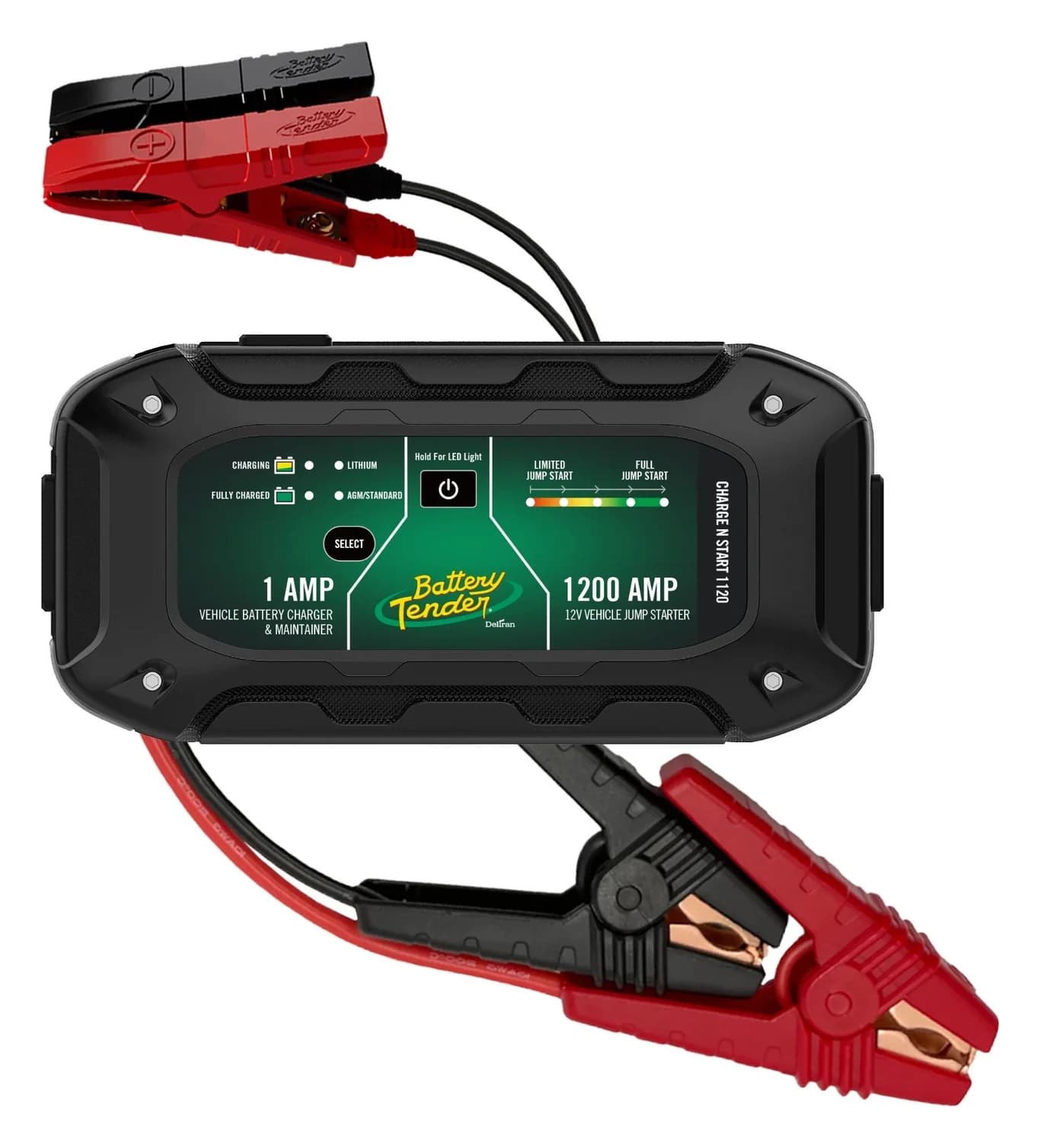
Best for stored seasonal vehicles
12V · 1 A max charge
Choose for: Best for stored seasonal vehicles
Check before buying: Sold out status indicates limited availability
- 5
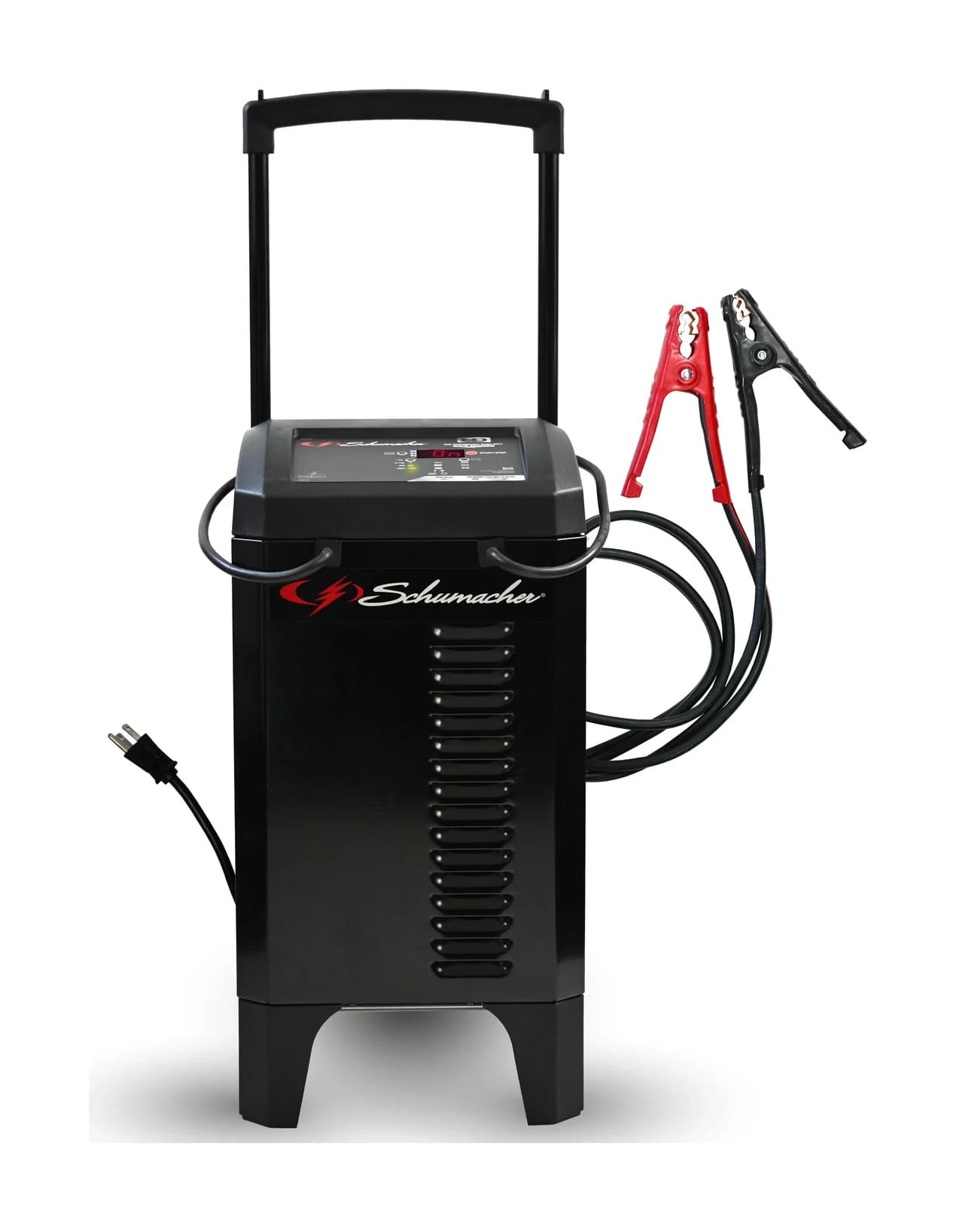
Best for larger gas and diesel engines
6/12V DC · 6 A max charge
Choose for: Best for larger gas and diesel engines
Check before buying: Requires constant AC power connection for engine start and boost modes; not a portable jump starter
- 6
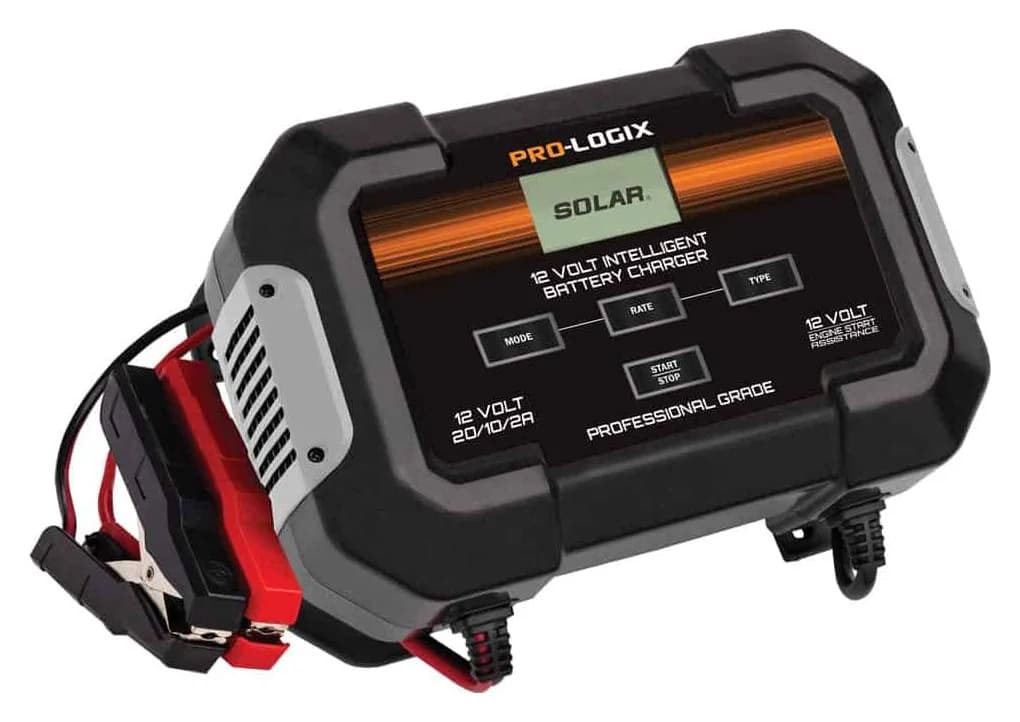
Best for heavy-duty shop charging
12 Volt · 20 A max charge
Choose for: Best for heavy-duty shop charging
Check before buying: Lead acid batteries only; the manual explicitly warns against charging lithium batteries with this charger
Highest charging current each maker lists
Charging amps only, drawn to scale from zero. Boost and engine-start amps are separate figures and are not shown.
Not recorded: CS FREE Adaptive Booster.
Warnings and sources
Jump starters, battery chargers and compressors involve high current, battery gases, heat and pressure. Follow the maker’s manual for the exact model and your vehicle’s owner’s manual; this guide summarizes published specifications and is not a set of instructions.
These units combine two functions: a smart charger that maintains and recovers 12V vehicle batteries, and an engine-start capability that either boosts the battery from a wall outlet or delivers jump-start power from an internal lithium pack. The critical distinction is whether the engine-start function requires a wall outlet. Every figure here comes from each maker's own product page or manual; no number has been estimated, converted or carried over from a different model.
The short answer
If you want one unit that charges, maintains, and can start your car from a wall outlet, the Schumacher SC1281 handles both 6V and 12V batteries at up to 6A with a 100-amp engine-start mode; Schumacher lists it as UL Listed (File: E32074, UL Model: 102-8) and as cETLus Listed (File: E32074). If you want a unit with an internal lithium pack that works away from a wall outlet, the Battery Tender Charge N Start 4120 combines a 4A smart charger with a 1200A internal lithium pack, rated for gas to 6.0L and diesel to 4.0L. If you need engine-start capability with no wall outlet at all, the CTEK CS FREE (40-462) recharges a dead 12V battery in 15 minutes using its own internal 66 Wh battery.
Quick picks
Compare specifications and all conditions
Plug-in charger with engine start, 6V/12V
- Best pick
- Schumacher SC1281
- Key reason
- 6A charge rate, Schumacher lists a 100-amp engine start, 6V and 12V, Schumacher lists it as UL Listed (File: E32074, UL Model: 102-8) and as cETLus Listed (File: E32074)
Charge-and-start combo, fastest charging
- Best pick
- Battery Tender Charge N Start 4120
- Key reason
- 4A charger + 1200A internal lithium pack, gas to 6.0L / diesel to 4.0L
No-wall-outlet engine start
- Best pick
- CTEK CS FREE
- Key reason
- 66 Wh internal battery, revives dead batteries in 15 minutes, no wall outlet needed
Long-term storage maintenance
- Best pick
- Battery Tender Charge N Start 1120
- Key reason
- 1A ISM float maintenance + 1200A jump starter, IP65 rated
Large engine start, wheeled shop unit
- Best pick
- Schumacher SC1325
- Key reason
- 250-amp 12V engine start, 40A boost, wheeled steel frame
Heavy shop charger with timed start assist
- Best pick
- Clore PL2545
- Key reason
- 20A charging, 28A start assist, 4-minute max boost from AC power
Full comparison table
Swipe to compare. Row labels stay visible.
| What you need | Best pick | Key reason |
|---|---|---|
| Plug-in charger with engine start, 6V/12V | Schumacher SC1281 | 6A charge rate, Schumacher lists a 100-amp engine start, 6V and 12V, Schumacher lists it as UL Listed (File: E32074, UL Model: 102-8) and as cETLus Listed (File: E32074) |
| Charge-and-start combo, fastest charging | Battery Tender Charge N Start 4120 | 4A charger + 1200A internal lithium pack, gas to 6.0L / diesel to 4.0L |
| No-wall-outlet engine start | CTEK CS FREE | 66 Wh internal battery, revives dead batteries in 15 minutes, no wall outlet needed |
| Long-term storage maintenance | Battery Tender Charge N Start 1120 | 1A ISM float maintenance + 1200A jump starter, IP65 rated |
| Large engine start, wheeled shop unit | Schumacher SC1325 | 250-amp 12V engine start, 40A boost, wheeled steel frame |
| Heavy shop charger with timed start assist | Clore PL2545 | 20A charging, 28A start assist, 4-minute max boost from AC power |
Scroll horizontally to see every column
| What you need | Best pick | Key reason |
|---|---|---|
| Plug-in charger with engine start, 6V/12V | Schumacher SC1281 | 6A charge rate, Schumacher lists a 100-amp engine start, 6V and 12V, Schumacher lists it as UL Listed (File: E32074, UL Model: 102-8) and as cETLus Listed (File: E32074) |
| Charge-and-start combo, fastest charging | Battery Tender Charge N Start 4120 | 4A charger + 1200A internal lithium pack, gas to 6.0L / diesel to 4.0L |
| No-wall-outlet engine start | CTEK CS FREE | 66 Wh internal battery, revives dead batteries in 15 minutes, no wall outlet needed |
| Long-term storage maintenance | Battery Tender Charge N Start 1120 | 1A ISM float maintenance + 1200A jump starter, IP65 rated |
| Large engine start, wheeled shop unit | Schumacher SC1325 | 250-amp 12V engine start, 40A boost, wheeled steel frame |
| Heavy shop charger with timed start assist | Clore PL2545 | 20A charging, 28A start assist, 4-minute max boost from AC power |
Best plug-in charger with engine start: Schumacher SC1281
The SC1281 is a wall-powered charger that also starts engines. It charges at 6A (or steps down to 2A for maintenance), boosts at up to 30A, and Schumacher lists a 100-amp engine start — all from its 120V AC connection. It supports both 6V and 12V batteries and automatically detects which is connected.
Schumacher lists its chemistry support two ways. The product description says the unit "supports both 6V and 12V batteries, including standard, AGM, deep-cycle, and 12V lithium (LiFePO4) battery types." The spec table lists only "AGM" as the battery compatibility type. Both are recorded here; follow the owner's manual for the definitive chemistry list for your battery.
The engine-start mode works from the wall outlet. Schumacher does not state crank or rest limits on the saved page — the owner's manual is the source for those. The unit has no internal battery; it must be plugged in during use. Schumacher lists the SC1281 as UL Listed (File: E32074, UL Model: 102-8) and as cETLus Listed (File: E32074), backed by a 1-year warranty. It weighs 10 lb and has no stated IP rating.
The SC1281 names four modes: a 100-amp engine start, a 30-amp to 12-amp boost charge, a 6-amp to 2-amp charging mode, and a smart trickle charge. Schumacher's own page describes the trickle mode as maintaining voltage "without worry" for long-term connection; the unit's automatic shutoff handles the overcharge protection. Schumacher also lists a battery reconditioning desulfation mode and a built-in battery and alternator tester.
Schumacher lists the output current as "2/6/30/100A" — the top figure applies to engine starting only, not to charging current.
Best charge-and-start for the money: Battery Tender Charge N Start 4120
The Charge N Start 4120 is a charge-and-start combo: it charges at 4A from a wall outlet and carries its own 1200A lithium jump starter that works independently from the AC circuit. Battery Tender rates it for gas engines up to 6.0L and diesel engines up to 4.0L.
It supports AGM, GEL, lithium (LiFePO4), and standard flooded lead-acid batteries. The compatible battery size range is 14Ah to 100Ah at 12V. The unit moves through four charging stages — initialization, bulk charge, absorption, and float maintenance — and Battery Tender states that once a battery reaches full charge, the unit "automatically drops to float maintenance mode" and delivers "float maintenance 24/7, indefinitely."
Two separate clamp sets are included, and Battery Tender explicitly warns that they are not interchangeable. The charging clamps are dedicated to ISM maintenance; the jump-start clamps are dedicated to the 1200A cranking function. Battery Tender's own warning on jump-start procedure is quoted directly: "Crank for up to 5 seconds per attempt with 30 seconds between attempts."
The 4120 page shows "Sold out" beside the add-to-cart button. No discontinued notice appears; the maker's page carries a "Notify Me When Available" option.
Battery Tender lists the following certifications: BC, cETLUS (UL1236), cETLUS (UL2743), DOE, FCC, ICES, and UN38.3. The unit carries a 1-Year Limited Warranty. The Input row lists "120V AC" with no stated frequency.
Best standalone option for no-wall-outlet situations: CTEK CS FREE (40-462)
The CS FREE is the only unit here that can bring a dead 12V battery to a start without any wall outlet. It has an internal battery rated at 66 Wh (polymer lithium-ion, 300 cycles to 80%), and CTEK states it "revives dead 12V batteries within 15 minutes without a wall outlet." It can also be used as a portable charger with a USB-C input or solar panel.
CTEK says the CS FREE "charges and maintains any 12V lead-acid or lithium (LiFePO4) vehicle battery" and lists compatible battery types as WET, MF, Ca/Ca, AGM, EFB, GEL, and LiFePO4. Battery capacity range is 10–130 Ah. It starts at 3.0V and operates in a range of -4°F to 122°F (ambient temperature). The unit weighs 3.09 lb and carries an IP54 rating. The warranty is 2 years.
The CS FREE is not a plug-in engine starter. CTEK does not publish peak or cranking amp figures for it. Its approach is to recharge the vehicle battery incrementally until it has enough charge to crank the engine, with a countdown function showing how long until the start can be attempted. CTEK's own description says: "Starts any 12V battery in 15 minutes."
The CS FREE has no mode selector — CTEK states "No need to select modes—simply connect, and the CS FREE will handle the rest." Input is USB-C (5 VDC to 25 VDC, 3 ADC, 60W max) via the included power adapter. The product page shows "Out of stock."
Best for stored seasonal vehicles: Battery Tender Charge N Start 1120 (model 1120)
The Charge N Start 1120 is a 1A ISM smart charger and maintainer combined with a 1200A lithium jump starter. Its engine ratings match the 4120 — gas engines up to 6.0L and diesel engines up to 4.0L — at a lower charging rate. Battery Tender describes it as "the smart battery charger, maintainer, and portable jump starter."
Battery Tender states the charger is compatible with 12V batteries from 14Ah to 80Ah, covering AGM, GEL, lithium (LiFePO4), and standard flooded lead-acid. Not compatible with 6V or 24V systems. The unit's jump-start function operates independently from the AC charging circuit, meaning the jump starter works without the wall outlet connected.
For long-term storage, Battery Tender's own words: "Once the battery is fully charged, the CNS 1120 automatically enters float maintenance mode and delivers only the micro-current needed to offset self-discharge." The unit has two dedicated clamp sets — not interchangeable — one for charging and one for jump starting.
Battery Tender states: "Crank for up to 5 seconds — most vehicles start within 1–3 attempts." The safety features listed are spark-proof connection on both clamp sets, reverse polarity protection on both, short-circuit protection, and overcurrent protection. The unit is rated IP65 and certified to BC, cETLUS (UL1236 and UL2743), DOE, FCC, ICES, and UN38.3. The warranty is 1-Year Limited Warranty. The page shows "Sold out" beside the add-to-cart button.
Battery Tender states the gas engine limit two ways on the same page: "gas engines up to 6.0L" in the spec area and "V6" in the description. Both versions are recorded; the liter figure is used in the comparison table because engine sizes are typically expressed in liters.
Best for larger gas and diesel engines: Schumacher SC1325
The SC1325 is a wheeled plug-in charger with a higher engine-start rating than the SC1281. It Schumacher lists a 250-amp 12V engine start and a 125-amp 6V engine start, with a 40-amp boost mode and a 6-amp to 2-amp charging and maintaining mode. Like the SC1281, it must be plugged in during use and has no internal battery.
Schumacher lists the chemistry support two ways. The product description says the unit is "compatible with 6V and 12V standard, AGM, gel, and deep-cycle batteries." The spec table lists only "AGM" as the battery compatibility type. Both are recorded. Schumacher does not name a lithium chemistry for this model.
The SC1325 is built on a steel frame with a retractable handle and wheels — it is the heaviest unit here at 28.4 lb. Schumacher names six functions: starts, charges, maintains, reconditions, and tests batteries, and tests alternators. The unit also includes an advanced desulfation mode.
The SC1325 is UL/cUL Listed (File: E32074, UL Model 102-11, cUL model 102-12, DOE, FCC) and backed by a 1-year limited warranty. No crank or rest limits are stated on the saved page; the owner's manual is the source for those.
Best for heavy-duty shop charging: Clore PL2545
The PL2545 is a 20A smart charger with start-assist capability that delivers a boost of up to 28A for up to 4 minutes when plugged in. Clore describes it as an "Intelligent Battery Charger / Maintainer with Start Assistance" for 12V batteries. Unlike the battery-tender units, the PL2545 is for lead-acid batteries only.
Clore's manual states the output as "12VDC 20A (28A start, 4 min max)" — the 28A figure is labelled only as "start," and no separate cranking or peak amp figure is given. The start-assist function is not instantaneous: Clore's engine-start procedure first requires "charge the battery for 10 minutes using the appropriate settings for the size and type of battery installed in the vehicle" before engaging the start-assist mode. In that mode, "the charger will attempt to raise the battery's voltage to a level suitable to start the vehicle, which could take several minutes."
The charging rates are 20A, 10A, and 2A. The unit charges flooded, AGM, gel cell, spiral wound, marine, and deep-cycle lead-acid batteries. The manual carries a direct warning word for word: "WARNING: This battery charger is designed to charge lead acid batteries. Using it to charge a lithium battery will result in serious property damage and/or personal injury."
AC input is 120VAC 60Hz, 4.5A continuous, 6A during start assist. The warranty is 1 year from date of original end-user purchase. No IP rating, weight, Ah range, minimum start voltage or operating temperature is stated on the saved page or manual. The manual's compliance lines state FCC Part 15 and Canadian ICES-003 (radio interference, not a safety listing). No UL or ETL listing is named for this model.
Comparison: how the picks differ
The fundamental split is whether the unit can start an engine away from a wall outlet.
- Yes: Schumacher SC1281: requires wall outlet for engine start
- No: Schumacher SC1325: requires wall outlet for engine start
- No: Clore PL2545: requires wall outlet for start assist
- Yes: Battery Tender 4120: internal lithium pack for wall-free jump starting
- Yes: Battery Tender 1120: internal lithium pack for wall-free jump starting
- Yes: Battery Tender 1100: internal lithium pack for wall-free jump starting
- Yes: CTEK CS FREE: internal 66 Wh battery for wall-free operation
- 100AEngine-start amps on the Schumacher SC1281 (must be plugged in)
- 250AEngine-start amps on the Schumacher SC1325 (must be plugged in)
- 1200AJump-start amps on the Battery Tender 4120 and 1120 (internal pack)
- 1200AJump-start amps on the CTEK CS FREE via its own internal battery
- 66WhInternal battery capacity of the CTEK CS FREE
- 6V & 12VBattery voltages on the Schumacher SC1281 and SC1325
- 12V onlyBattery voltages on the Battery Tender units and CTEK CS FREE
Engine-start figures: what each label means
These units use different terms for their starting functions, and the labels are not interchangeable.
The Schumacher units call theirs "engine start." The SC1281 lists "100-amp engine start" and the SC1325 "250-amp 12V engine start, 125-amp 6V engine start." These figures are draw from the wall outlet — the units must be plugged in.
The Battery Tender units call theirs "jump starting" and publish their figures as peak amps: "1000 AMP Jump Starting" for the 1100 and "1200 AMP Jump Starting" for the 1120 and 4120. These are the output of the internal lithium pack and are measured in peak amps — they are not the same kind of figure as the Schumacher engine-start amps.
The CTEK CS FREE publishes no peak or cranking amp figure. Its engine-start function works by recharging the vehicle battery incrementally until it has enough charge to crank the engine.
The Clore PL2545 names no separate cranking or peak figure for its start assist. Its manual lists the output as "12VDC 20A (28A start, 4 min max)" — the 28A is labelled only as "start," and the procedure requires charging the battery for 10 minutes first.
Never compare engine-start amps from a wall-powered charger with the peak amps of a lithium jump pack. They are measured differently and mean different things.
How to choose
Do you need to start the car without a wall outlet? If the unit must work away from power — in a parking lot, at a campsite, or anywhere the car is not near an outlet — choose a charge-and-start combo with an internal lithium pack. The Battery Tender Charge N Start 1100 (1000A), 1120 (1200A) and 4120 (1200A) all carry internal lithium packs, as does the CTEK CS FREE (66Wh internal battery). The Schumacher SC1281 and SC1325 and the Clore PL2545 require a wall outlet for any engine-start function.
What engine size are you starting? Battery Tender rates the 1100 for gas engines up to 5.0L and diesel up to 3.0L. The 1120 and 4120 step up to gas up to 6.0L and diesel up to 4.0L. Schumacher rates the SC1325 for 250-amp 12V engine starts, with no separate gas or diesel limit stated on the saved page. The CTEK CS FREE's collection page says it "starts any 12V battery in 15 minutes. — no engine size limit is stated.
Do you need 6V support? The Schumacher SC1281 and SC1325 both support 6V and 12V batteries. The SC1325 also lists a 125-amp 6V engine-start mode. The Battery Tender units and CTEK CS FREE are 12V only.
How fast do you need to recharge a depleted battery? Clore lists the PL2545 as delivering 20A of charging current (or 28A in start-assist mode, timed to 4 minutes maximum). Clore lists the 4120 as delivering 4A; Clore lists the 1100 and 1120 as delivering 1A. The CTEK CS FREE charges the vehicle battery at its own rate — from its internal battery or from a USB-C source — with the countdown function showing progress.
What about long-term storage? The Schumacher SC1281 and SC1325, the Battery Tender units, and the Clore PL2545 are all designed for long-term connection with automatic float maintenance. The CTEK CS FREE can be used as a portable charger in the field but is not a dedicated long-term maintainer. Battery Tender's own wording on the 4120: "float maintenance 24/7, indefinitely" with no overcharge risk.
How we choose
We ranked these units on their makers' published specifications. For each pick we read the product page, spec table and manual from the manufacturer, looking for current-generation models from established brands with published charging profiles, defined battery compatibility, and documented engine-start or jump-start functions. Where a maker's own pages disagree — Schumacher's description and spec table on chemistry for the SC1281, for instance — we report both versions and the page each came from. We excluded anything marked discontinued by its maker, and we never opened Amazon pages. Every figure traces to an official source listed in each product record.
The CTEK CS FREE and the Battery Tender 4120 and 1120 are listed as sold out on their makers' pages at time of research. No discontinued notice appears on either site; "sold out" may reflect temporary supply conditions.
Verdict
For a garage that stays near a wall outlet: the Schumacher SC1281 handles both 6V and 12V batteries at 6A with a 100-amp engine-start mode, and its spec table is consistent with UL Listing. For a bigger garage with larger engines to start: Schumacher lists the Schumacher SC1325 with a 250-amp 12V engine start on a wheeled frame. For a unit with an internal lithium pack that works away from a wall outlet: the Battery Tender Charge N Start 4120 combines a 4A smart charger with a 1200A internal lithium pack, rated for gas to 6.0L and diesel to 4.0L. For long-term storage with wall-free jump capability: the Charge N Start 1120 at 1A is built for staying connected indefinitely. For a wall-free option that recharges the vehicle battery itself: the CTEK CS FREE has its own 66 Wh internal battery and works without any wall outlet at all. For heavy shop use with timed start assist: Clore lists the Clore PL2545 with 20A of charging current and a manual procedure that walks you through the start-assist process step by step.
Frequently asked questions
What's the difference between a plug-in charger with an engine-start mode and a charge-and-start combo?
A plug-in charger with an engine-start mode (such as the Schumacher SC1281 and SC1325) must stay connected to a wall outlet during use; it boosts the battery to start the car rather than jump-starting it from an internal battery. A charge-and-start combo (such as the Battery Tender Charge N Start units and the CTEK CS FREE) charges the vehicle battery from AC power but also carries its own internal battery so the jump-starter function works away from a wall outlet. Both types can be left connected long-term for maintenance.
Can I use these units to jump-start a car without a wall outlet?
The Schumacher SC1281 and SC1325 cannot start a car without being plugged in — they draw their engine-start current from the wall. The Battery Tender Charge N Start units (1100, 1120, 4120) and the CTEK CS FREE have internal lithium batteries that work away from a wall outlet. The Charge N Start units deliver their rated peak amps immediately; the CS FREE recharges the vehicle battery first, which CTEK says takes up to 15 minutes.
What battery chemistries do these units support?
The Schumacher SC1281 description lists standard, AGM, deep-cycle, and 12V lithium (LiFePO4) batteries, though its spec table names only AGM; both are recorded. The Schumacher SC1325 lists standard, AGM, gel, and deep-cycle batteries in its description, again with only AGM in the spec table. The Charge N Start units and the CTEK CS FREE list a broader set including AGM, GEL, lithium, and standard lead-acid chemistries. The Clore PL2545 is for lead-acid batteries only; its manual warns against using it to charge a lithium battery.
What are the crank and rest limits for jump-starting with these units?
The Battery Tender pages state a limit of up to 5 seconds per attempt with 30 seconds between attempts. The Schumacher SC1281 and SC1325 pages do not state crank or rest limits — follow the owner's manual for those units. The CTEK CS FREE uses a timed countdown approach: it shows how long until the vehicle battery has enough charge to start the engine.
Can I use these on 6V batteries or 24V systems?
The Schumacher SC1281 and SC1325 support both 6V and 12V batteries. The Schumacher SC1325 also lists a 125-amp 6V engine-start mode. All three Battery Tender Charge N Start units are 12V only and are not compatible with 6V or 24V systems. The CTEK CS FREE is 12V only.
Related guides
Explainer · Car Battery Chargers
Portable Car Battery Chargers Explained: Charger, Maintainer or Jump Starter?
The three devices that share 'portable car battery charger' cover different jobs. This guide sorts them out using each maker's own published figures and engine ratings.
Buying guide · Car Battery Chargers
Schumacher SC1281 Review: 6V/12V Charger with 100A Engine Start, Explained
What Schumacher's SC1281 6V/12V plug-in charger does in each mode, its chemistry-list discrepancy, and why its engine-start amps need AC power.